In ways I’ve never quite fully understood.
It has rained all day, causing mudslides on the ashy slopes and making the gullies run, no doubt reducing the dirt roads to soup and unfortunately delaying Landlady’s visit – which I’m told will be care package-rich, when it happens.
But as I said, I’ve spent this (yet again uneventful, during my convalescence) morning watching the system voltage. During the most cloudy times the voltage readout isn’t particularly different from what it’s always been, maybe a few tenths higher…
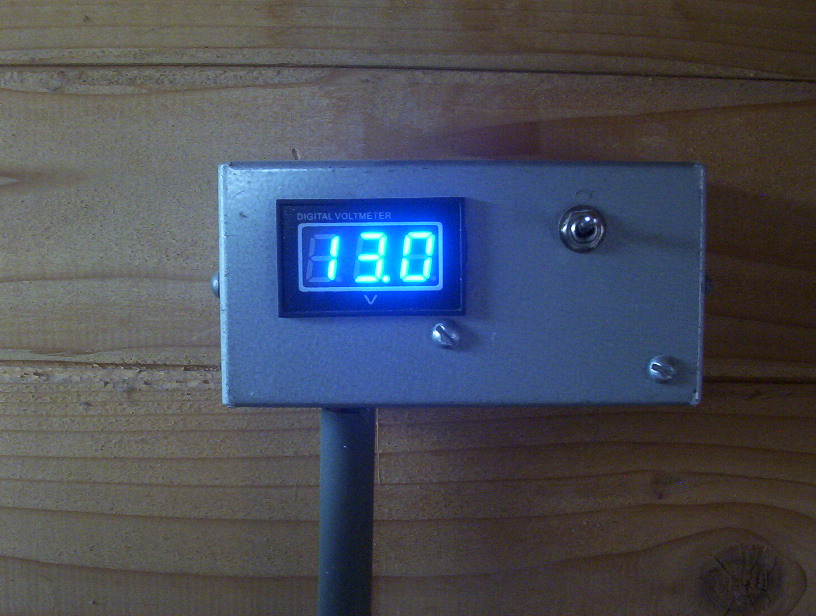
But at moments when the sun pokes through enough to cast any shadow, it promptly jumps to 14.3 which is the maximum the charge controllers will allow, which means the batteries are indeed fully charged at mid-day – on as gloomy a day as we’re likely to see.
It never used to do that before, so having two charge controllers pouring current into the batteries from two different sets of solar panels is having a good effect – even if it doesn’t necessarily show up on the voltage display.















It might be the two charge controllers interacting. They don’t always play nice together.
According to my neighbor who knows more about this stuff than I do, these two are compatible. You’re not supposed to run a PWM with an MPPT, but two PWMs are fine.
Ok sorry to elbow my way in but…….there might be a mistake on the internet……on your page!
I am assuming your using typical type deep cycle batteries, not car batteries…then 14.3 may not be right, could be low, and that would then be deficit charging your batteries, and shortening there life.. they may need a better soaking of current and that takes a controller that’s adjustable to 14.9 or 15 volts. I set them to 14.8 bulk charge and the float to 13.4-13.5 (for typical room temps) Don’t trust me though, check it out your self, here is the data sheet for a typical deep cycle battery
http://www.trojanbattery.com/pdf/datasheets/T105_Trojan_Data_Sheets.pdf
A lot of the controllers don’t charge to a high enough voltage and have fixed outputs that you cant adjust. I have had great performance with the old xantrex C60, it has two knobs to adjust bulk and float voltages, nice and simple to use…The Tri Star C60 is another, but I hate having to set tiny little dip switches with my old eyes, and it costs more. The xantrex is old school construction, not a single surface mount component in it, all through hole construction. If anything burnt up you could fix it yourself (not that I have seen a single failure). Here is a link to the product . https://www.altestore.com/store/charge-controllers/solar-charge-controllers/pwm-solar-charge-controllers/xantrex-solar-charge-controllers-pwm/xantrex-c60-charge-controller-60a-1224v-c60-charge-controller-60a-1224v-p2071/
its also the most efficient PWM I have used and tested..Just be sure is all I am saying…batteries are expensive!
I just read back on some of your old posts and see that you do have a tri star c60…so you can adjust bulk and float to whatever you wish…