A couple of weeks ago I learned that the Jeep’s fuel pressure was less than half of specification. Since the engine was actually running pretty well, that meant the ECM had cranked the fuel injector pulse width to eleven to compensate for the low pressure. The only real issue the (probably) failing fuel pump was causing was vapor locking. I wondered what would happen if I ever had to clear the codes before getting the problem fixed. Then a couple of days ago, chasing my ignition system problem, I disconnected the battery to clean the contacts. I knew that I was thereby testing my theory about the fuel injectors, possibly to my detriment. It just seemed unavoidable.
Yeah – Theory confirmed.
I use the Jeep to haul all the chickens’ water to Landlady’s ridge, which has no water pressure at all. So before I lose the Jeep starting tomorrow I really needed to fill 5-gallon water bottles.
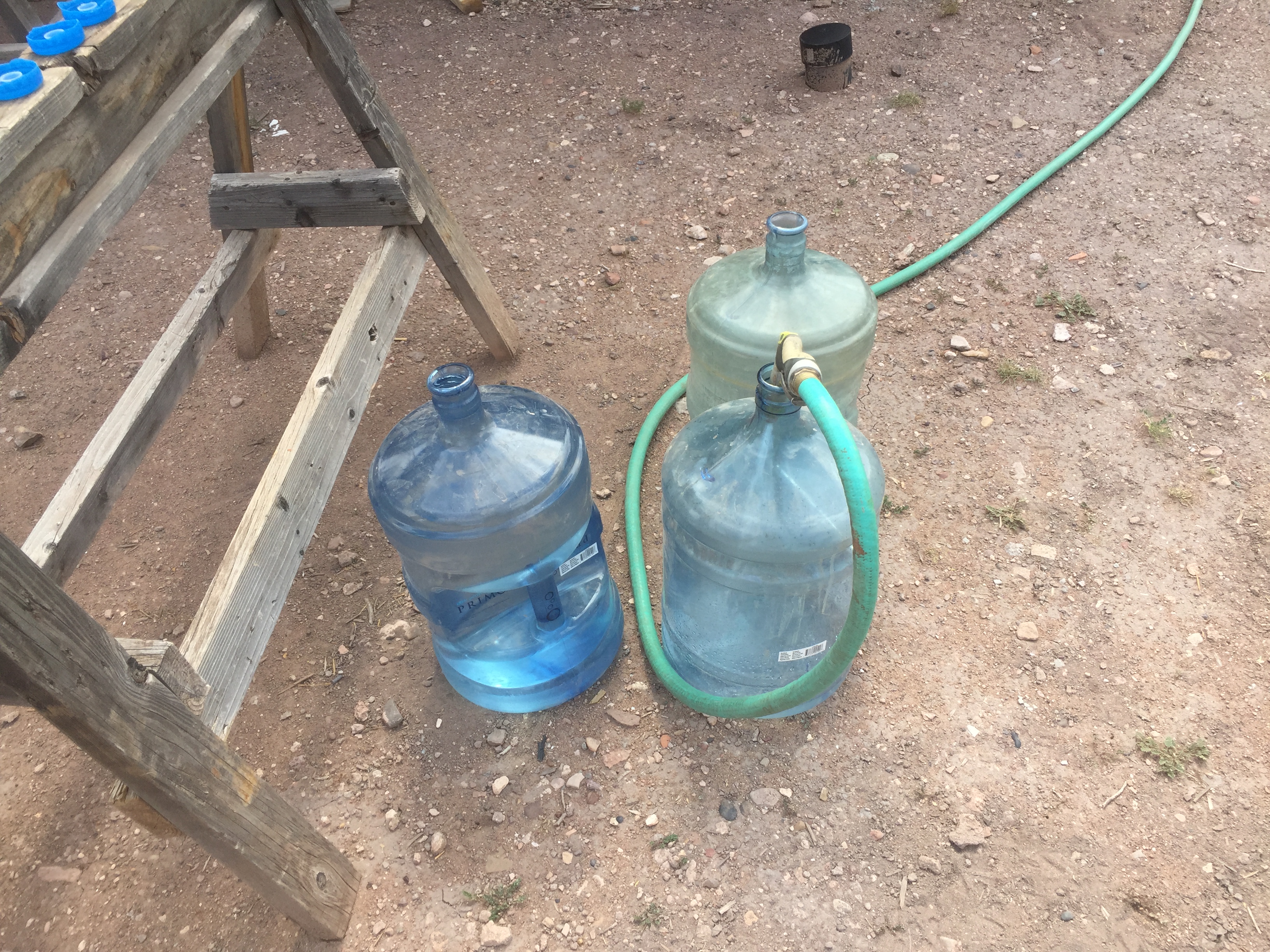
That meant drive to the ridge, get the bottles, take them back to the Lair and fill them, drive them back to the ridge. It’s a little over a mile by road, about half a mile across country with some steep hills. No way I’m walking with those bottles. Ergo, we’re going to find out how the Jeep behaves in heavy sand while possibly running super lean. Hey, I had to do it sometime anyway: No way it’s climbing the driveway hill cold, so the only way to the road is through the wash. If it bogs it bogs. But I should have warmed it up first – I can’t say exactly when the ECM on a 2001 Jeep updates its a/f settings but it can’t possibly happen before the oxygen sensor warms up, right? So that was dumb.
Down the driveway to the wash was simple enough, it’s a straight line downhill. Could have gotten there with the engine off. But as soon as I hit the sand and turned right, the engine sagged and I truly didn’t think I was making it through the wash. I did, barely, and fortunately the ECM considers air/fuel ratio really important because by the time I had to do it again the Jeep was running as well as it ever does.
So really, that just sets me up for tomorrow’s trip.














Glad you’re not stranded.
Never occurred to me that the friggin’ fuel pump was computer controlled. I must be old…
For some reason, “I was thereby testing my theory…possibly to my detriment” immediately brought Ghostbusters to mind. Y’know, “Don’t cross the streams!”
Sorry, no actual useful commentary.
Just wondering, what would it entail to de-ECM the Jeep? They used to run just fine without anything even vaguely resembling a computer; is it even possible to go that far back in time with it, mechanically, and if so, is it feasible?
I would rather have an ECM than a mechanical distributor any day! They don’t make cars like they used to, and that’s mostly a GOOD thing. When it comes to cars, the “good old days” weren’t actually very good.
The fuel pump runs constantly whenever the ECM is active, that’s the only way it’s computer controlled. It supplies an overabundance of fuel to the injectors, the excess being constantly routed back to the tank. The ECM can’t measure fuel pressure, only air flow and the oxygen content of the exhaust gas. On the other hand it can’t control the air flow but has complete control over the fuel flow through the injector pulse width, which (in the eighties, when I used to teach this stuff, and if I’m remembering correctly) could be controlled to a hundredth of a millisecond. To increase the fuel flow it just makes each injector pulse a little wider. In my case I suspect it’s making them a lot wider to compensate for the low fuel pressure.
And Ben is right, people who crave a return to pre-computerized engine controls don’t remember how much more reliable cars suddenly got in the mid-eighties. I wouldn’t go back to a mechanical distributor and a (shudder) carburetor for all the ammo in Brownell’s. Just look how long this poor thing has run virtually without maintenance since 2008, when T died and left it in my broke and isolated hands. Hell, it’s run for the past year with a failing fuel pump. When I started driving the word for a car that went 10,000 miles without a major tune-up was junker, if it ran at all.
I can go years without thinking about this stuff, and it’s been a long time. But I recall a funny story: When I was a wrench I always assumed the in-tank fuel pump was a sparkless design, because of course it was: It was surrounded by gasoline. Then one day another guy and I pulled a tank to replace a pump that had completely failed: This was back in the days of Throttle Body Injection and I mostly worked on diesels so I didn’t know diddly about it.
Anyway, we pulled the tank and found a bad connection that had been sparking so enthusiastically it had melted all the insulation around it. I’m pretty sure we both went white as a sheet. It bugged me for a long time: Why would such an obviously dangerous condition even be made possible? A few years later I tagged along with my new father-in-law to a Bendix plant where they designed and tested fuel injectors. It was my first encounter with an actual automotive engineer, and I barely understood what he was saying. But I girded my loins and asked my possibly stupid question: How come that tank didn’t grenade?
He looked at me as if he’d suddenly noticed he’d been keeping company with a cockroach: “Liquid gasoline isn’t flammable,” he … well, actually he rather sneered it.
I said, “Yeah, but the pump isn’t always immersed in gasoline. You wouldn’t want sparking when it’s surrounded by fumes.”
He wasn’t done with me. “The fuel pump sparks constantly.”
I think I managed a “huh?”
“It’s a brush-type motor. It sparks constantly.”
“But…”
“You do know that gasoline vapor is heavier than air, right? So the fumes pressurize the tank and force the air out through the vapor canister, the tubing for which is at the top of the tank. Gasoline fumes without oxygen are also…not flammable.” And with that he apparently regarded the kindergarten lesson at an end.
I long since confirmed it: The fuel pump inside the tank sparks constantly, in perfect safety.
Reading comprehension failure on my part. I saw “pulse width” and was thinking that modulated power to the pump. Comes from being a digital guy. PWM is one way to do motor speed control. At least it was in the old days. Dunno what the kids are usin’ nowadays. Carry on sir, yer doin’ fine. Thanks for the clarification.
As for mechanical distributors ‘n stuff… I used to drive a bloody Brit sports car with an electrical system by Lucas, aka The Prince of Darkness. The new-fangled stuff ain’t fixable by mere mortals but it don’t hardly break, neither.
Norman,
Practically speaking, no way Jose. But if you want to really feel old, manufacturers started installing computers on cars in the late 70’s. At the very least, I have pulled trouble codes off of a 1982 Camaro. At one point, General Motors was the largest producer of computers in the U.S.
One other possible cause of pressure problems in a constant-flow fuel system is the pressure regulator.
The fuel pump applies pressure to the fuel rail from which the injectors draw, with excess fuel being returned to the tank through the pressure regulator. This allows the pump to be run continuously without stalling.
In some cars, the regulator often has a vacuum port to allow for the pressure to be varied with engine load. Of course the most modern vehicles probably control that by computer. Lose the vacuum hose connection on that port and you can have pressure issues – usually excessively high. Lose the diaphragm in the regulator, and similar funky stuff can happen.