A week or so ago I mentioned that I’m working on my very first ebook, titled “A Solar Electric System On the Cheap, On the Fly, and Off the Grid”.
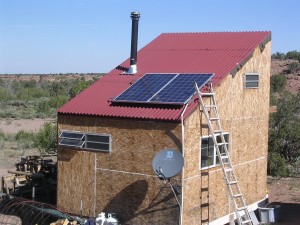
Unlike most of my projects this one trotted along just fine: In fact it’s been essentially done for a few days now, except for formatting and outside editing. The current draft has everything in it I intended to say. I let it sit a while, went back and re-read it, and I’m not unhappy with it.
Except that it’s appallingly short – only about twenty pages. Twenty chatty pages. I promised “brief and simple,” but this is so brief that I’ve about convinced myself it’s not enough. There’s almost no technical detail about how a person really, properly goes about planning and building a solar power system. It’s only about the ones I built, and I do mention frequently that I didn’t do it the real, proper way. It’s got lots of pictures.
I’m thinking I need to go back and add more technical detail about the right way – except that I’m not really qualified to write that. I’d just be gleaning it from other books or free stuff on the web. Anybody can do that, and probably get it righter than I would.
I do try to make that point in the conclusion, which I only wrote last night…
At this point you’ll begin to notice I haven’t given you much information about how to build your own solar power system. Isn’t there a lot of math and electrical engineering? What about panel angle vs. longitude? (or is it latitude?) Determining true south? Calculating kilowatt/hours? I do confess I didn’t do any of that, but there’s lots and lots of free information available for those who want to be properly efficient. I found most of it incomprehensible, but then I really am a little bit math-challenged. My panel angles are the way my roof pitch happens to be. (This is the way most people actually do that.) They face magnetic south, and can bloody well like it. I just made up that thing about kilowatt/hours, because I don’t really know what they are.
I never really learned what I was doing, and that’s the whole point I’m trying to make: My system works! I am as unqualified to do something like this as you ever dreamed of becoming, and the Secret Lair in all its dysfunctional glory is living proof that if I can do it anybody can.
For so many years I was that guy who dreamed about that secluded little place in the boonies, knowing damned well I had no talent or resources to ever bring such a thing about. Circumstance pushed me into the situation head-first, but I did gradually find that none of it was completely outside my ability if I’d only give it a try. None of what I’ve built is perfect. A real builder would laugh at some of it.
So what? It works!
But this morning that just feels like a copout.
What do you think? Stick to what I know, which is short but to the point? Or go back and take the time to write a real manual?













I suspect you know others who have built similar systems, some with more $$ and, probably, some with less. Couldn’t you gather their stories, tales of woe, trials and errors – and pictures if they are willing? Invite them to tell their stories, either anonymously or with attributions.
Yes, there are undoubtedly many very competent manuals and books about how to do it the right way. I think the charm of YOUR book will be found in the very fact that you are no expert and did a lot of things the hard way. Most people will relate to that, even if they go out and buy the other books before they start. Or not…
You were successful. Share the success and the encouragement that it CAN be done without the big bucks.
Not having seen the book, I couldn’t be sure what it needs or doesn’t. But how about just a few sidebars labeled “The Right Way.” As in “The Right Way: How to find true south,” “The Right Way: the best angle for solar panels,” etc.
And this being an ebook, you could just write a few words of your own, then have some links to better (though hopefully still uncomplicated) information.
I agree that the book really does need to give people an idea of how they could build a solar power system on the cheap. But I can’t see why it has to be yet another complete guide to solar. Let it mostly be just what it is, about your own experiences. But toss in some detail photos, a wiring diagram or whatever. Treat those sidebars as extra tips.
Just pack the e-book with some pictures of Zoe, Clicker, Little Bear, and Ghost. All the important reads will be happy. 🙂
I suggest you don’t clutter it up with a re-hash of what solar electric is, what it does, etc. But I would include something on the older system that Claire helped fix, specifically why it didn’t work out as well as was hoped, and the lessons learned that you incorporated into the Secret Lair.
Don – That’s already there. That was a good idea.
Sounds like a best seller as is. Short and to the point.
How are the graphics? Are there graphics? I’m an ape and I likes me some pictures in my book learning.
Pictures of wiring that even for people like me who are well accustomed to automotive wiring diagrams that might as well be in old Chinese text can better follow rather than vague schematics that everyone(me) screws up?
Joel – where I start to get pissed off is when I pay for something and then find that it’s not as described. So how you describe the product is important.
Case in point… If I’m recalling correctly you don’t have refrigeration (food) on your system – and I’m not sure if you have a form of hot water heating. Both of these can be done with gas – but that’s expensive and adds another twist to ‘off the grid’.
Different people have different expectations – but most of us have been conditioned to the incredible convenience of refrigeration and hot water on demand. I don’t know many people who would willingly do without just these two things – or who have even spent much time considering what they’d do alternatively to achieve them. That may say something about your target audience.
I’ve paid attention to and talked with a number of people over the last 20 years or more who have solar systems and have almost always found that there’s a fair amount of adaptation involved in gearing one’s life to them. It hardly needs said that there’s very little ‘one size fits all’ to the proposition.
I strongly believe in the value of decentralised energy production – so I hope my comment isn’t taken as a negative.
Another thing… IIRC there’s another solar system that handles your water well situation. That’s another very important aspect of any decentralised energy system. (if’n you live in a desert where the water is a few hundred feet or more below you)
I’d echo Plug’s comment – never been unhappy with any purchase that lived up to its description, whatever that description might have been. That might be a good point to make in the book, though – solar’s about as customizable as you can get in terms of determining what you want to power in your life. Maybe just a section on deciding what’s important and building accordingly, like your evolution from batteries through generators to a one-panel to two?
I’d also love to see a breakdown of what you’d change – would you get away from gas and heat with solar if you could? Any interest in a hydroponic setup, or maybe a freezer? What’s been hard to get used to/easy to do without, and why?
Looking for more personal experiences/explanations of decisions made, less technical stuff. Cheers!
Good points, all. Thanks for the comments.
ML, I’m not enthusiastic about pictures of the neighbors’ rigs, but stories of troubles and what they’d do differently might be useful. I can think of three people I could talk to about that.
Claire: I like the idea of “how to do it right” sidebars, though how to fit it into the formatting is something I’d have to work out. I’m just using a freebie word processor, and don’t know how far I can stretch it. What did you use for your snitch book?
Buck, there are lots of photos of both of the Lair’s systems and a couple of very simple block diagrams. No wiring diagrams at present, though I have considered adding some for battery wiring which can be confusing.
PNO, it’s funny you mention expectations because I had the same thought. I’m careful to describe the things I can use my very small system for and the things I don’t think I can. Refrigeration is on the second list. It’s funny you mentioned the well pump, though, because that never occurred to me.
Anon 3:23, I’ve got you covered, too. There’s already a page comparing my experiences with solar, wind, and fuel-powered generation. I even mention hydroelectric, but hey. Desert. I have no informed opinion on hydroelectric.
“What did you use for your snitch book?”
I used somebody who knew better than I how to format ebooks. What can I say?
Are you going to publish this as a Kindle book? I learned that they don’t do actual sidebars-on-the-side well. But you can just, for instance, do something like this at the end of any given section:
—————————————————–
THE RIGHT WAY: FINDING TRUE SOUTH
Blahblah blah blah blah
__________________________________
Maybe put the type in italic to distinguish it from the main body text. I really don’t know a lot about books designed for e-readers, but that worked on the mobi files of the snitch book, thanks to Anon Layout Guy.
I think that part of the point of *your* book is that you don’t have to be an EE, Tesla or even an electrician to cobble together a solar system that works. Nor do you have to be wealthy.
I suspect that there may be more than a few folk that are intimidated by the whole inverter/panel/battery/wiring thing. That may be where you come in.
Or not….worth exactly what you paid for it.
UnReconstructed
“Refrigeration is on the second list.
I’m probably mentioning things you’ve already heard of – but just in case…
Have you considered whether a tri-powered (gas/AC/DC) RV-type ammonia refrigerator might work for you? I’ve fiddled around with them a bit but haven’t yet tried to run one from solar – though I can’t see why it wouldn’t be do-able. (given enough wattage/storage)
I’ve seen a couple evaporative ‘refrigerators’ that would keep items down in the 50’F range – better than nothing is probably all I should say about them!
Wait a few weeks – you’ll be able to keep perishables out on your porch in a cooler!
(Zoe said you could just put that cooler on top of your woodstove…)
Write about what you know. Don’t write about what you don’t know. If you try to include tech stuff that you don’t know, you vastly increase the chances of misleading people. As you point out, the tech stuff is freely available. Include some links if you know of any that are especially good. Otherwise stick to your story. You write well, it’s a good, true story. Keep it that way.
Good luck!