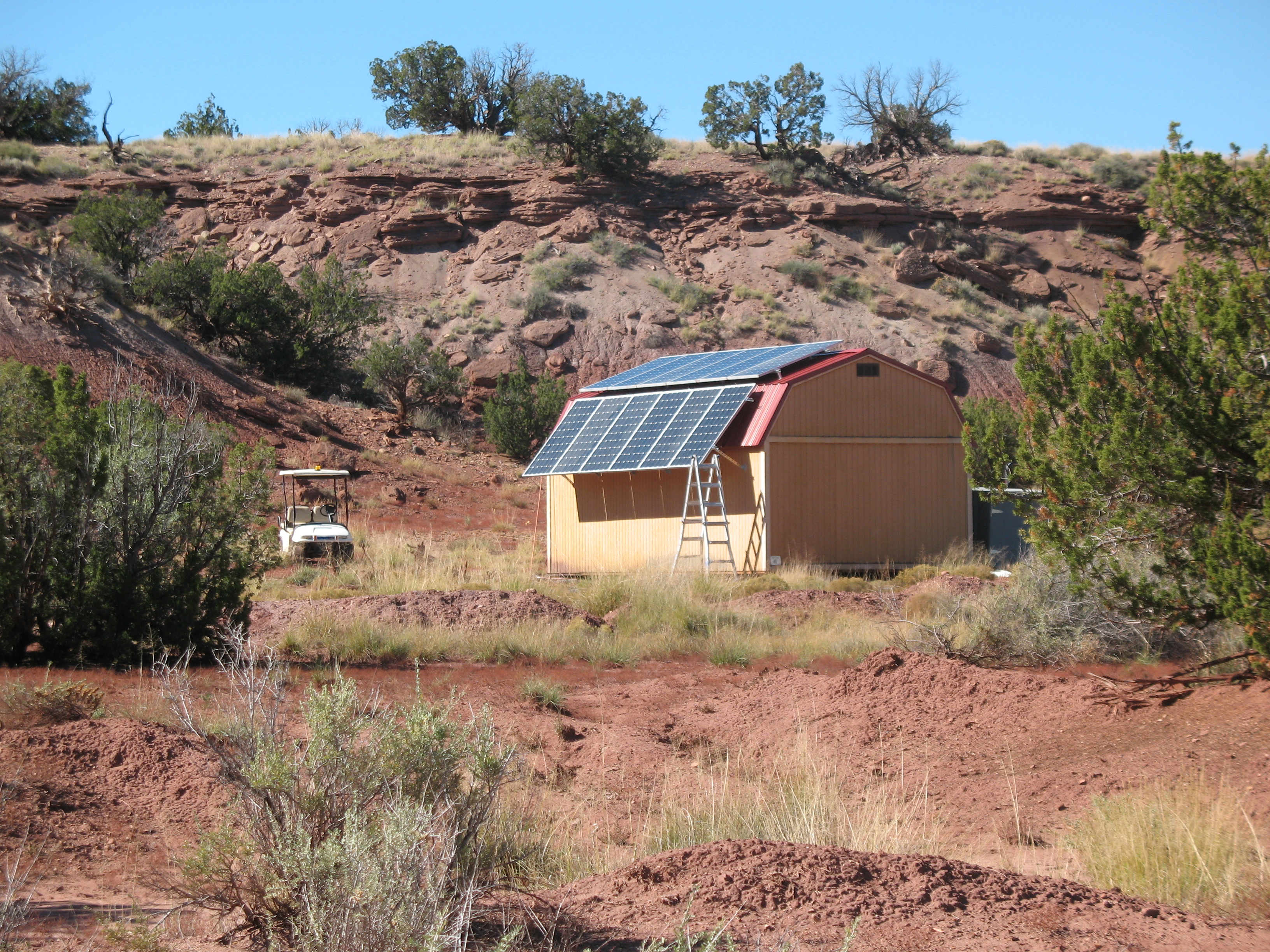
This is a long-delayed step toward moving a new neighbor in. It’s not as though I’m anxious to fill the place up with people – if a developer started clearing land for a subdivision I’d be outraged to the point of dynamite fantasies. But a sufficient population of the right kind of people is essential to my gulching dream. And you may have noticed we’ve had some depopulation issues lately.
This new guy, despite some health issues, is our kind of people. Actually he’s hardly new, he’s owned that parcel for quite a long time. But today I got to help hang the panels for his electrical system. S the weekender neighbor is doing the real installation. This custom rack answered my much-repeated question, “How do you plan to get twelve panels on that dinky roof?” The theory is that the array is somewhat overspeced for the battery bank, and half the panels are ideally angled for the summer solstice and half for the winter solstice. A lot of people setting up their panels for the first time plan on seasonal angle adjustments, but give it up early. It’s been my experience that the exact angle doesn’t matter as much as the manuals insist as long as you have enough panels to start with. The important thing is to not overwhelm your panels with batteries to be recharged. Slightly more panels than you need is the right amount, and then you can forget worrying about resetting angles for the season.















This is something I could probably google if I weren’t so lazy (not to do the search, but to sort through all the useless $%@# it would return), and you might already know the answer. One set of the new neighbor’s panels are oriented perfectly for December 21, the other set for June 21; that seems like a workable solution – much better than trying to get monkey-motion hardware to consistently work properly – but I’m curious: what’s the efficiency drop-off as the two sets transition through equinoxes, which should be the lowest output days ? Or, does the lower sun angle early AM and late PM each day negate some of that efficiency loss?
Alternatively, would it be better to angle both sets for equinoxes and accept the drop-off at solztices?
I am just glad you don’t get the kind of hail we do. All I can see there is potential broken glass. Or is it made of something hail proof? Anyway, good deal. Good neighbors are a treasure. 🙂
Nosmo, that last thing is what most people do: Set a compromise angle and accept that efficiency at either end of the solar cycle will drop off. Exactly how much it drops is a debated question which I have not studied: Possibly in the neighborhood of 20%, which is of course hardly insignificant. But Chinese solar panels with excellent service life can be had for a dollar a watt, which means obviating the whole issue by simply throwing more panels at it is the way most people go. Indeed that’s why nobody bothers with tracking mounts anymore. They never worked especially well, and they’re far more expensive than just hanging a few more panels on a fixed rack.
As to the double-angle rack in the picture, I really think my neighbor is just making a virtue of necessity. On that roof he’d had needed some pretty extreme racks to bring everything to the same angle, so why not make the two rows work best at both extremes instead of trying to split the difference?
ML, we do get hail sometimes but not windshield-breakers. I’ve never heard of hail damage on solar panels around here, and honestly don’t know how much impact it would take. The real danger is wind.
ML: most poly panels are rated for 1″ hail. The mono panels use tempered glass and flexible epoxy sandwich with the panel at the center. These actually have some give to them and the four that I have survived a hail storm unscathed. 3/4″ hail but I was sweating it out prayin’ that they survived. (The angle set up helps some; if they had been laying flat, I am not as confident they would have made it.).
I actually prefer the poly panels due to ease of maintnance. Those glass panels get corroded at the connections and are a real bear to repair. I did a post about that a couple of years back because several of my readers also run the HF specials. I back up my system with wind and that seems to be working quite well. The only down side to it I found was with certain wasp breeds. They like to set up shop up there, and get a little irked when the whole shebang gets shredded by moving parts. Hard to keep ’em off when that area is 30′ off the ground.
The efficiency is simply related to the sine of the angle between the sun rays and the panel surface. At 90 degrees the efficiency is 1.0, at 80 degrees it is 0.98, at 70 degrees it is 0.94, at 60 degrees it is 0.87, at 50 degrees it is 0.77, at 40 degrees it is 0.64. Given that the sun sweeps from 22 degrees above the horizon at noon in winter, to 68 degrees above at noon in summer (assuming you’re at 45 degrees latitude), it seems like it should make sense to point it directly at the winter sun at noon. Then you can never be more that 46 degrees off in summer, and the efficiency at 46 degrees is 0.72 (anyway there is lots of sun in summer). Also the sun spends lots of time at the solstices, and little at the equinoxes. Winter is where you want to maximize your array.
However I’m no solar installer; I could have a mistake in here somewhere!
BTW if you set it at the equinox, in the middle between winter and summer (your compromise angle), you will be 23 degrees off in both summer and winter. 23 off of 90 is 67, where the efficiency is 0.92. So you will be giving up 8% of your winter efficiency, to get better collection in the summer when you (probably)don’t need it. Also the amount of time the sun spends at that equinox angle is the least.
A compromise angle a little toward winter will boost summer a lot at little cost in winter. Remember if you are off 10 degrees from optimum, your efficiency only drops down to 0.98, a 2% loss in winter which may be more acceptable. So setting it 10 degrees above the winter optimum may be a better compromise than the equinox angle.
One other thing. The closer the panels are set to winter optimum, the less trouble you will have with summer hail…
I dispute none of the above. But if you throw sines and cosines at most of the people I know around here – not excluding me – you’re going to get hostile, uncomprehending glares. Then they’ll shrug, and if their battery banks are not topping off by early afternoon they’ll go out and buy more panels. Though you do make a very good case for winter optimization.
In fact now I think about it, most people just top off with generators when the weather’s uncooperative. I never think about that, because I hate all electrical generators in any class I could ever hope to afford – I spent a year and a half repairing them, and they’re (ahem) well, ‘trash’ is so harsh. Since I hate having to baby unnecessary machinery, I pretend they have no utility at all and refuse to own one. Most of my neighbors do not agree, which – to get back to the point briefly – lets some of them get away with inadequate panel arrays.
My calculator says Mr. Bonneau is correct, and he pointed out something that had not occured to me: days in summer are much longer than days in winter, so an efficiency penalty in summer from panel angle is more easily compensated for by longer duration sunlight periods. The best of both worlds would appear to be a two-position adjustable mount, position A for maximum efficiency during the winter equinox-to-equinox period and position B for the similar summer period. Using his example for 45 degrees latitude, that would require a 45 degree panel angle change, assuming one accepts being one degree off during summer, and half of that – more easily accomplished mechanically – sacrifices a small amount of summer efficiency which sunlight duration should fix; I’ll have to research the available watts per hour numbers at my latitude to find the balance point.
Yeah, everything I was writing about referred only to performance at noon. The fact (as you recognize) the sun is in the sky much longer in summer means optimizing for summer is even less important – unless you are trying to run refrigeration with the panels!
I do know that a lot of people are not comfortable with trigonometry, which is why I hate government schools so much – the concept is both useful and well within almost anyone’s capabilities, if the schools were not so successful in fostering ignorance and inadequacy. Like Vin Suprynowicz says, they should be demolished so that not one stone is left standing on another, and the land sown with salt.
Anyway bottom line, if you don’t want to move panels, point panels south toward sun at solstice at noon, or a few degrees above it, and you’re good.
Ooops, just thought of another factor. In winter it is often cloudy and a lot of light the panels receive comes not directly from the sun, but bouncing off clouds, etc. If you have the panels pointing so low on the horizon, the panels “see” less sky and more ground. So maybe the way to do it is just wait till near winter solstice, try to pick a typically cloudy day, and just tilt panel back and forth while monitoring output. Tighten things down when you see the max…