Yup, it’s that time.
In our last exciting episode, one of Landlady’s pullets had had some sort of leg-breaking accident. I gave it several probably excruciating days to see if it could get its act together, but it was clearly getting worse. In the poultry world, the treatment for this is extreme.
Uncle Joel has never done this before. Oh, I’ve killed and eaten animals. But they were all mammals, I shot them all at a decent distance, and I didn’t know any of them personally. So this new experience incorporated quite a few firsts.
By the way: There will be a quiz. This little chicken may not appreciate the honor of the occasion, but it is the very first meat ever produced here at the gulch. So this is kind of a significant moment and it’s going into Landlady’s freezer, not Uncle Joel’s oven. Enter performance anxiety. I can’t just do it, I have to do it right.
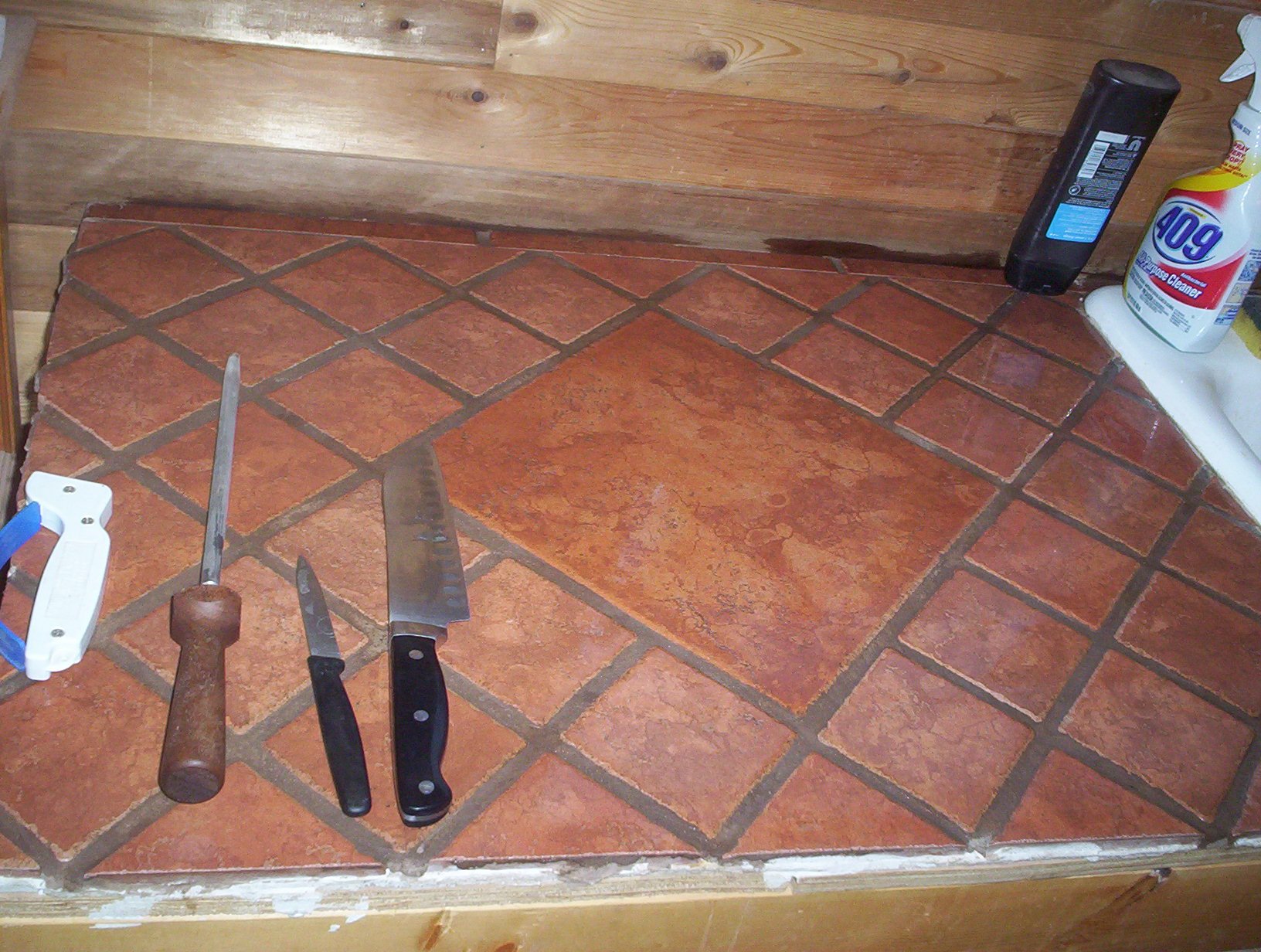
So let’s keep things clean, shall we?
After the clean-up and blade-sharpening, we went out and applied the anesthetic.
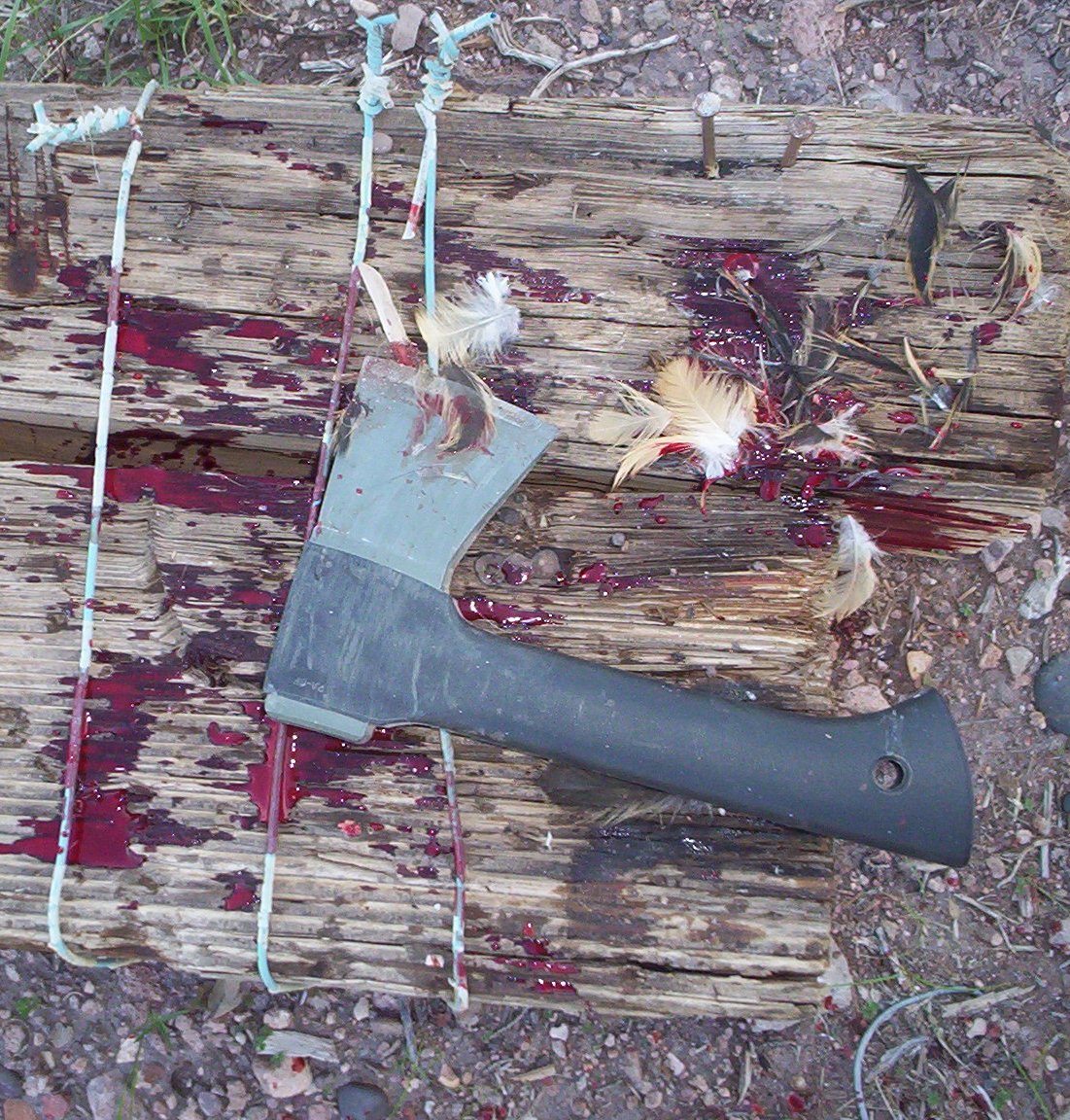
That’s right. Don’t mess with Uncle Joel. Cut your head clean off.
Those two nails at the upper right of the block are important. You hook the skull in there, pull back on the body, and the chicken will quiet down and give you a nice clean chop. I got that from my book.
And a more experienced neighbor told me: “You know that part about letting them run around? Unless you’re into blood everywhere, don’t do that. Keep control of the body, and keep the stump pointing away from you.” Good advice.
Pluck or skin? I went for skin, because I don’t have a pot big enough to scald a chicken. Skinning a chicken is a lot like skinning a rabbit, except messier. Rabbits don’t have feathers.
Cleaning a chicken, btw, is a lot easier than cleaning any mammal. Just open up its ass and scoop out everything gooey, then rinse. Doing it without nicking the gut is extremely easy.
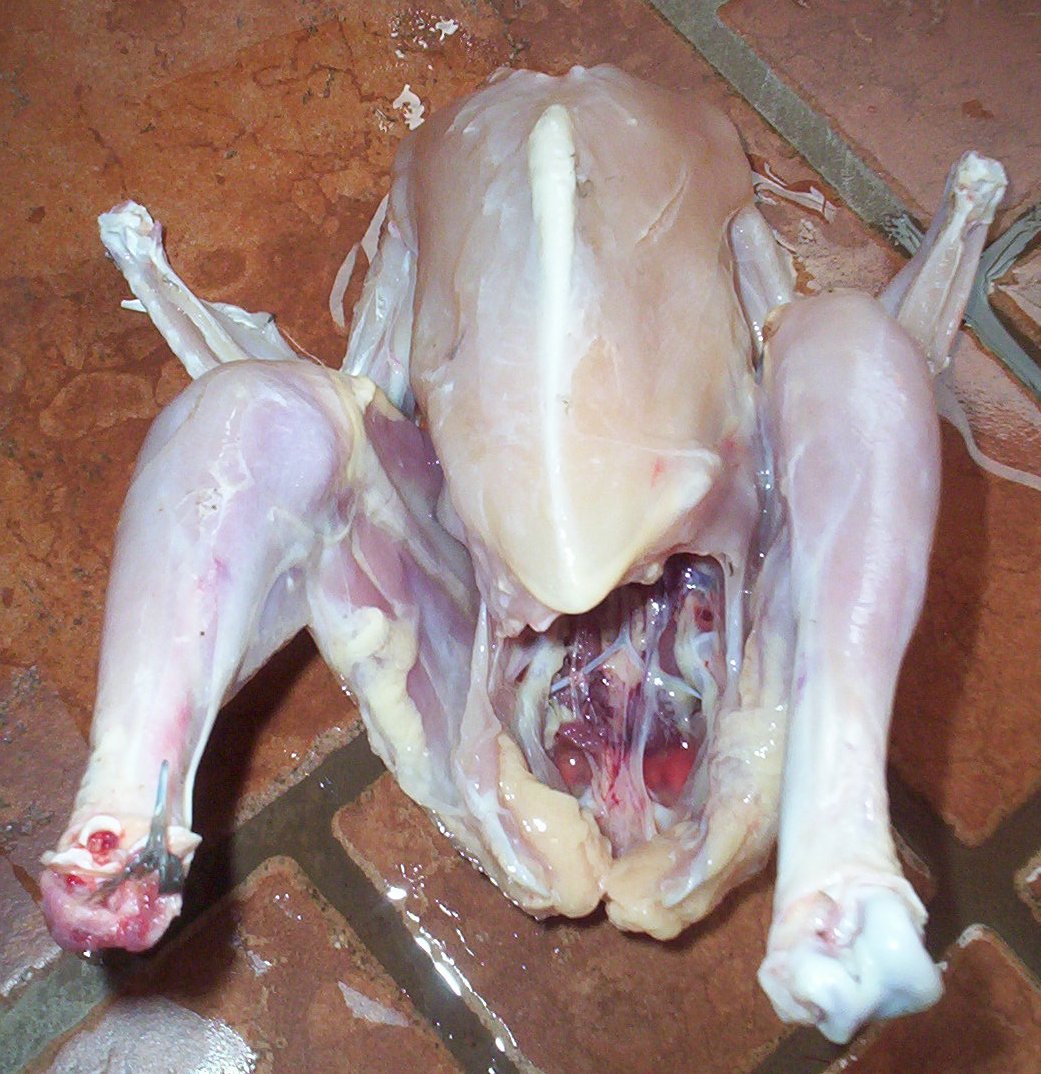
And there we are.
And you can tell this poor thing did indeed break its leg, can’t you? Right at the joint where it seemed to be broken when it was alive. That musta hurt.
Hardly a complete meal, but I think this calls for some sort of occasion. That one little chicken carcass represents well over a year’s work on the part of at least two people.
ETA: Landlady and Ian said I should just eat it myself, the wimps. So there’s roast chicken on the menu today.
ETA2: Worst. Roast. Chicken. Ever. Change of plan, now making pressure cooker stew.














Bravo! And I always skinned them too. I LIKE the skin nice and crispy brown, but not enough to go through all that plucking crap. The fact that we did a dozen or more at a time would certainly factor into that. 🙂 When we butchered the turkey one year (a WHOLE other story), we did the dunking and plucking thing faithfully because a roasted turkey without a crispy brown skin was really hard to imagine.
I just wonder why you would not have eaten this one. You certainly did your share of the work to get it to this stage.
The whole chicken thing was Landlady’s idea, Landlady’s investment, and a joint effort of three people. This first slaughter, though small and unplanned, seems a sort of significant moment I think it would be appropriate to share. Otherwise I would cheerfully eat it myself.
I can see where skinning would be much easier, but you can’t replace that flavor from the fat that comes with the skin when you’re making broth, etc.
I used to use one of those big dog cones that they get after doggie surgery so they don’t lick the wound. Reduce the neck opening size, nail it to a tree branch then just pop the chicken/duck/goose into it head first. Hold the head and one powerful knife stroke beheads it and the cone controls any post mortem thrashing.
Congrats on achieving the next step in your self-sufficiency quest!
Yeah, I recommended the “killing cone” in a comment to the previous post.
Ah, well . . . perhaps next time.
😉
RE: ETA2 — was the problem with the chicken itself or the cooking technique? BTW, this is why we had you try it first… 😉
was the problem with the chicken itself or the cooking technique?
Yes.
Joel,I haven’t killed all that many chickens (10?),but I’ve killed and eaten 100’s of quail,pheasants,and partridge.I usually skin ’em,clean ’em and freeze them until I have enough to bother with.I rarely try to roast them(too dry),rather I put them in the crockpot overnight,usually in water,you can put in a chicken bullion cube and some seasoning,and when they’re cooked,the meat will fall off the bones.Then you can eat the meat or use it in pot pie,soup,chili,etc.Wild birds (or farm raised birds used for egg production)are usually dry and strong tasting.I think we all get used to the taste of supermarket birds,and they have so many chemicals and hormones and fat on them that they taste different.You have to dream up some recipes where the birds that you used for eggs get more juicy and tender as they cook.
Brining the bird might help a bit – but conventional roasting probably will still get you a dry and tough bird. Most brining is some variation of salting and soaking – but I’ve even heard of people brining with soda pop. Like others have said – skin it and you lose the fat. Fat = carmelisation = tasty! A dutch oven would give you some of the effect of the crock pot – but might even allow for some browning.
Yeah, this was just an experiment. I thought maybe I could get away with roasting because it was such a young bird, but it had almost no body fat. Without the skin it was hopeless. What came out of the oven looked like an anatomy lesson. So into the pressure cooker it went, and it stewed up quite nicely. A waste of propane, perhaps, but the bird wasn’t wasted.
Clearly, though, I need to get a dutch oven or something that will help me sift out the bones.
Joel,The more I thought about my previous comment,it’s probably near impossible for you to run a slow cooker overnight,with your power situation.Considering that,you might consider roasting the bird wrapped in bacon,to help keep it moist.
Just for our information,I’d be interested to know a little about the limits of your electric and propane utilities.e.g.,how long (or short) do you try to keep your cooking times?I know ,you need to use as little power as possible,but can you run your oven for hours,can you use an outdoor fire,how long does your propane last if you bake a lot(bread day)?
I haul in all my propane in 7-gal bottles and it’s running around $2.50 a gallon so it’s a serious expense, but one bottle gives me several hours’ oven time. I bake bread once or twice a week and it’s rarely a problem. One day I might get really ambitious and try to build a wood-fired bread oven outside, but truly I doubt I’ll use it much. They’re such a hassle to fire up that it’s an event. So I’m stuck with propane.
As for electric: My biggest daily draw is my laptop. When it’s sunny there’s no particular limit on its use. I can’t stay up late enough to deplete the batteries just using computer and lights. My inverter will run power saws, but you can watch the power draw down when I do it so I keep them to a minimum. If the weather’s cloudy, all electric use is rationed, because to run the batteries too far down too often is to damage them. I got really lucky acquiring the batteries I’ve got, and couldn’t afford to replace them.
No matter how big or elaborate your solar power system is, your electricity supply is finite. They invariably turn users into lightswitch nazis, and I’m no exception.
Wow,now I kinda feel bad.Here I am telling you to leave your slow cooker on all night,and you have to even limit your light use.How ’bout a smoker,outdoors?Do you have enough firewood to roast the chickens over fire?
Not trying to pick on you,but I’m curious.I have often toyed with the idea of the kind of lifestyle you lead.Could you cook over fire indoors using your woodstove?I know chimney fires are a concern.
On another subject,have you ever looked into the miniature steam turbine generators?I think they would run on your woodstove,and make enough power to run your laptop.Just things I wonder,when I don’t have anything productive to think about.
Joel,
Maybe you could whip up some sort of solar oven with a pot in the middle. Using my googlefu, (http://www.inspirationgreen.com/solar-cookers.html) it looks cooker with “aluminized cardboard panel cooker can heat food up to 250 degrees Fahrenheit”. To me “aluminized panel” shouts cut up cardboard box wrapped in tinfoil… And if you use a solar cooker it won’t heat up the Lair, like the stove does.
Joe
I could cook over fire, of course. I’ve got lots of small wood, and it’s free. Propane’s simpler, cleaner, easier, and the cost isn’t prohibitive. I use propane in the kitchen because it’s better and I can. I don’t use electricity in the kitchen, even though a slow cooker might be better for some things, because I can’t. Believe me, I’m always juggling the pluses and minuses of available resources.
I’ve never heard of this steam turbine generator of which you speak. It sounds interesting, but I very much doubt I could afford one.
Joel,
I recently butchered 25 cornish cross chickens, which was my first foray into meat birds (have had layers for several years). One thing I learned in my research, and unfortunatley experience, is that you need to let the bird “rest” (on ice) for 36 to 48 hours prior to cooking or freezing (unless you cook within an hour of butcher). This “rest” period allows the rigor mortis to go out of the meat. If you don’t do this the meat will be tough and unpalatable. I experienced this with the first test bird we butchered, it was like leather. The birds we let rest were great, just like store-bought, but home made better. My brother made a short video of butcher day and put it up on youtube, you can find it here if interested: http://m.youtube.com/watch?v=tmDkbPJEvql
Have enjoyed you blog,
Drew
Bad link. Try this one: http://www.youtube.com/watch?v=tmDkbPJEvqI&nomobile=1