I really wanted to get the long wall done, but…
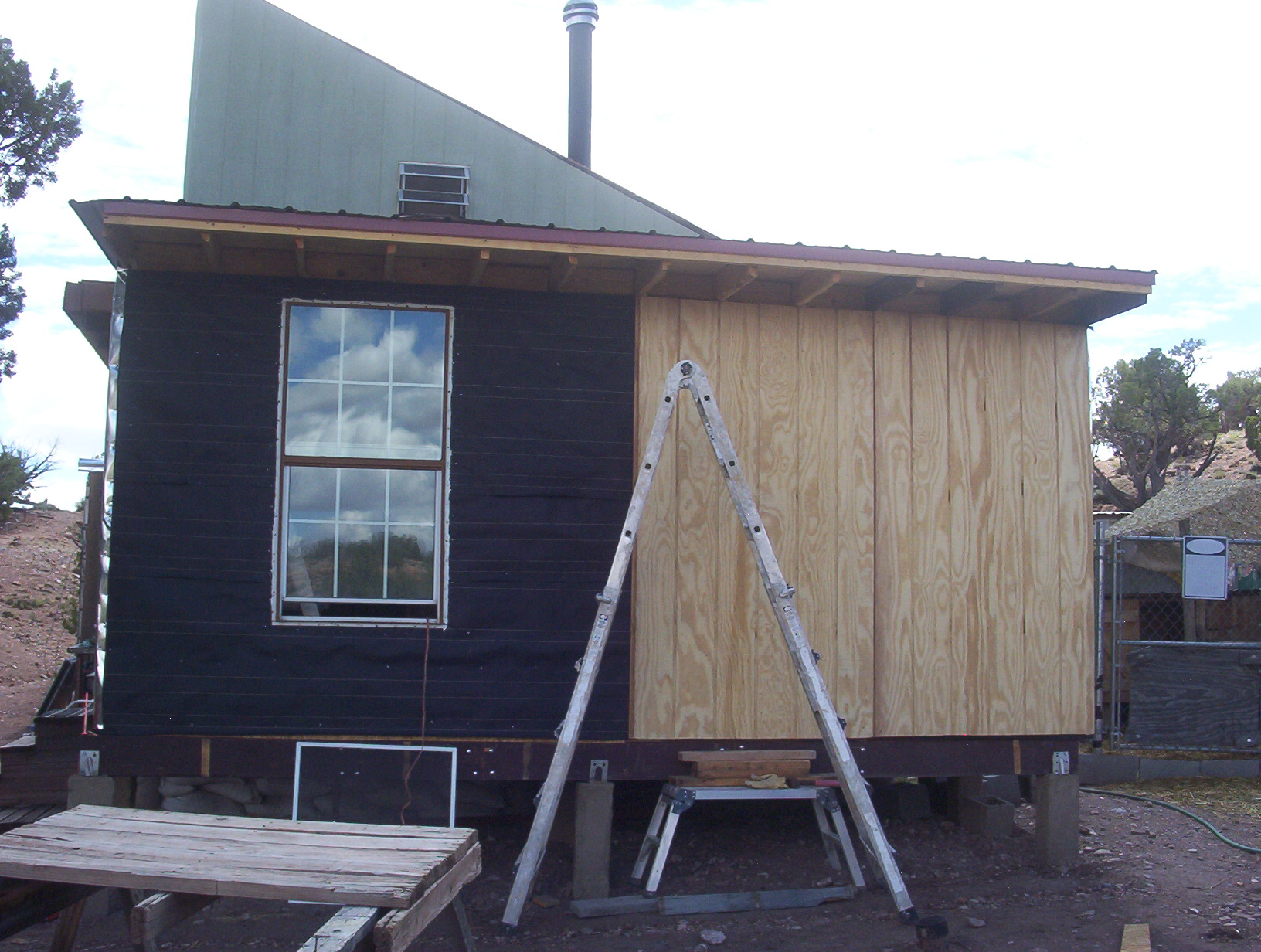
You know what I didn’t do? (Long-time readers will be shocked! to hear this) I didn’t do my homework. Clearly there are different grades of plywood and pressboard siding, and I just say “T1-11” while trying to look casual, like I know what the hell I’m talking about…
For the Lair I expected to use cheap pressboard and ended up with 3/8 plywood*, which was obviously an improvement. This time I asked for the same thing and ended up with 1/2″ plywood which – judging from the weight – contains a center layer of pure neutronium to help combat those pesky cosmic rays.
Oh, yeah. I expected some problems doing it myself but figured I at least had the advantage that I was going to bump them right up against the rafters so I’d have that as a steadying influence. Hold it up with one hand, screw it in place with the other…
Riiight.
I ended up doing this…
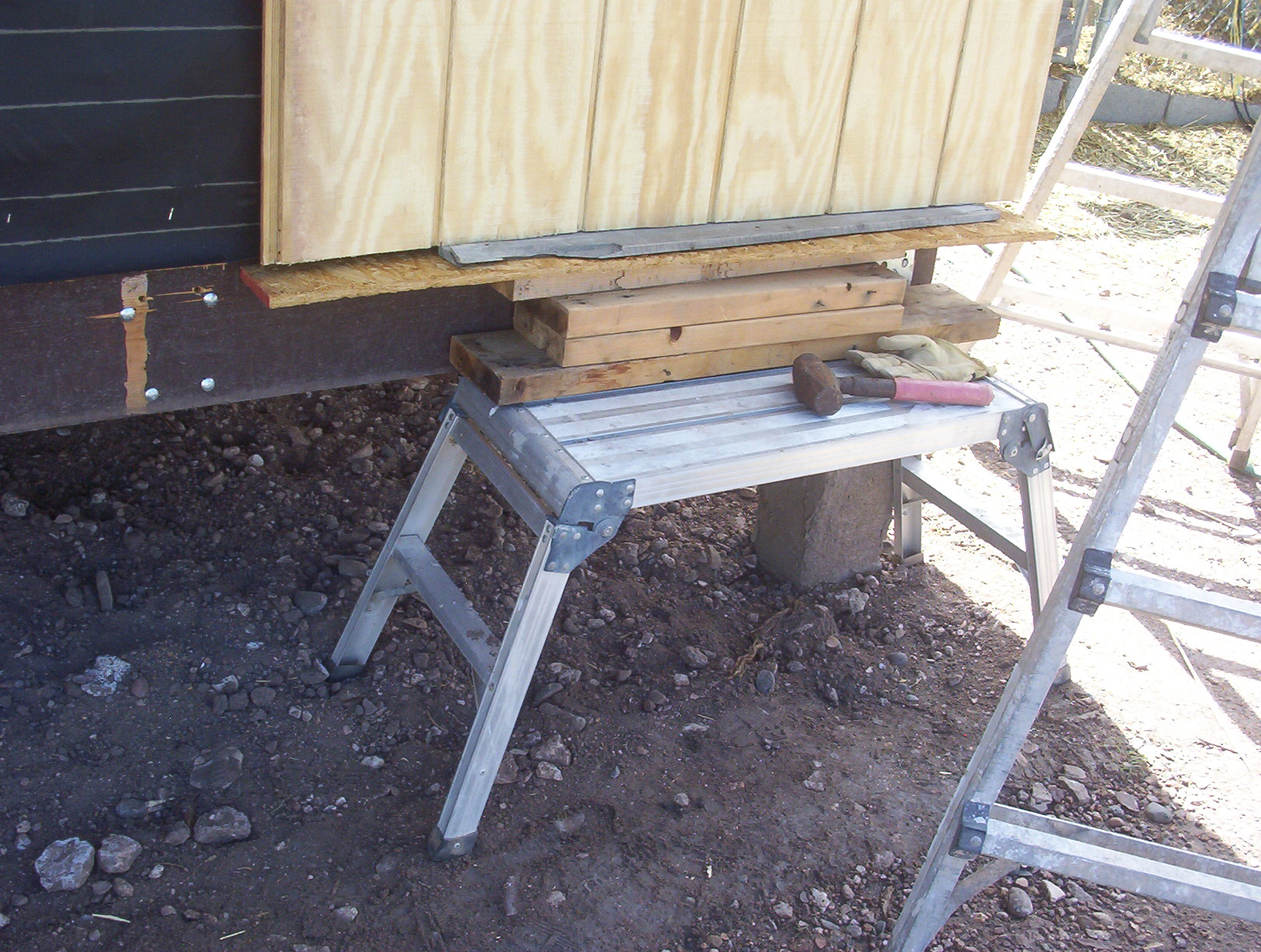
Very, very carefully. So carefully, in fact, that I only got hit in the head by plummeting plywood one time! But it did work. Eventually.
Now it’s still half an hour to noon, I’ve only hung two sheets, and I feel like I’ve dug half the road to Burma single handed.
Those might actually be the hard ones, though, because all the others ought to have a sort of hook I can hang from the windows to take the weight while I line them up.
Ought to.
ETA: I did get a third one up around the window, but had truly run out of steam by then. Also it turned out there was a problem with the corner flashing, so I fixed that instead of stumbling ahead and probably ruining a good sheet of siding.
—
*Except the south wall, which used extremely heavy hardi-board.














As long as it works…..one thing to get used to if you’re doing solo work: cleats. Cleats everywhere, for everything. Punch a couple of cleats in to support the sheet. Long ledger boards and you’re working solo? Cleat to hold one end up. Fascia for the roofing and you’re working solo? Cleat one end. Doing drywall solo? etc etc. Been doing this for years, because I absolutely hate working with crews.
Would it be worthwhile to screw a 2X4 across the bottom to act as a shelf to rest the plywood on? I’d think that that would be easier than trying to hold it up.
D’oh! Didn’t see czechsix’s comment before I put my own $0.02 in. Nevermind:-P
C6 and Jabrwok, I don’t know why I don’t think of these things. That’s a wonderful (and probably very standard, but I didn’t know about it) idea.
Tally ho, now I’m going to go try it.
Oh, there’re plenty of little tricks out there that you have to develop when you’re working alone. Very few folks actually know about cleating – every other handyman and contractor has always been surprised by the idea. I’ve never met anyone else, at least locally, that ever uses them. They opt to go to the local Home Depot parking lot and hire a day worker at $15 an hour, and then micromanage them because they’ll screw things up when you’re not looking. ;{
Then again, handymen here go for $30-$40 an hour, so I guess it’s worthwhile not working efficiently LOL.
For panelling, I put in a couple of nails…drywall, it is screws. Same idea, but a lot quicker, especially if you have a hammer with a nail groove or drill with a magnetic bit. Slide the sheet into place, brace with whatever major body part is close enough, (shoulder, hip, etc.) and drive the fasteners deep enough to catch, but not so deep as to not be able to take them out again. I did a three story building in hardiboard with an extension ladder, 8d nails and a good hammer that way…I DO NOT recommend that approach. I figured out that starting at the bottom is easiest for that one.
And you have your sheet on the cleat, use your flat bar between the sheet and the cleat to lever it up the last quarter inch to the rafters before you screw it on. Folks will look at the fine results and think you know what you were doing.
Read up your Archimedes texts a bit, you almost have the concept right, only I would recommend a nice long 8′ or longer 2×6 and a cinder block or bucket with stones at the long end with the little platform and 4×4 as fulcrum close to wall to lever up the sheet and hold it against the rafters until a couple of screws are inserted. Leverage is your friend when working alone
Cleats, stepped cleats and wedges, for those of us who perpetually work alone.
Stepped cleat: 2X lumber with short pieces of 1″ – 2″ wider 1X lumber (a piece or two of 6-8 inch lengths of 1/2″ plywood work well) on the exterior face; provides a lip to prevent the panel from slipping off the cleat.
A stepped cleat can be made as one unit, or by adding the exterior “flange” to a cleat after lifting the panel into place. If one does a lot of one person panel work, make some cleats with rotating plywood tabs – lift panel, set on cleat, rotate tab(s) to prevent panel from slipping off cleat.
Wedges: cut from 2X lumber, used to elevate panels held in place by stepped cleats the last inch or so into the correct position for nailing/screwing into place.
Cleat Crowd: If’n y’all could include a picture, us illiterates might grasp the concept better. Yeah, I know commenting is text-only. A feller can dream, can’t he? The failing is at my end, not yours.
Robert, in carpenter parlance a cleat or ledger in this case, is a length of 2×4 temporarily affixed flat on to the bottom of the wall so that you could rest the bottom edge of the T111 board on it. Effectively accomplishing the same thing Joel did with his step stool and a stack of lumber, but a bit less wobbly.
Huh. I just learned something. Thank you. To me, a cleat is where you tie off a bow or stern line so your boat is still there when you come back from lunch.