I replaced the Lair’s toilet with its very first brand-new one in February of last year, so not quite two years ago. You’d think that qualifies as practically brand-new, but that’s because you don’t have to deal with our water. I keep replacements for the flapper, the (old fashioned, as it turns out) float, and the valve because I know that each of those parts absolutely will fail, at the worst possible time in the worst possible way, and so there’s no excuse for not having replacements.
No excuse at all.
When I plumbed in this new toilet it didn’t escape my notice that the valve used a float design with which I’m not familiar. But no problem – I figured – when J&H moved away and left a whole big building full of stuff they paid me to dispose of, I inherited 3 toilet valves of perplexing design. I tossed them into a box in the powershed, assuming – there’s that word – that at least one would fit when I needed it.
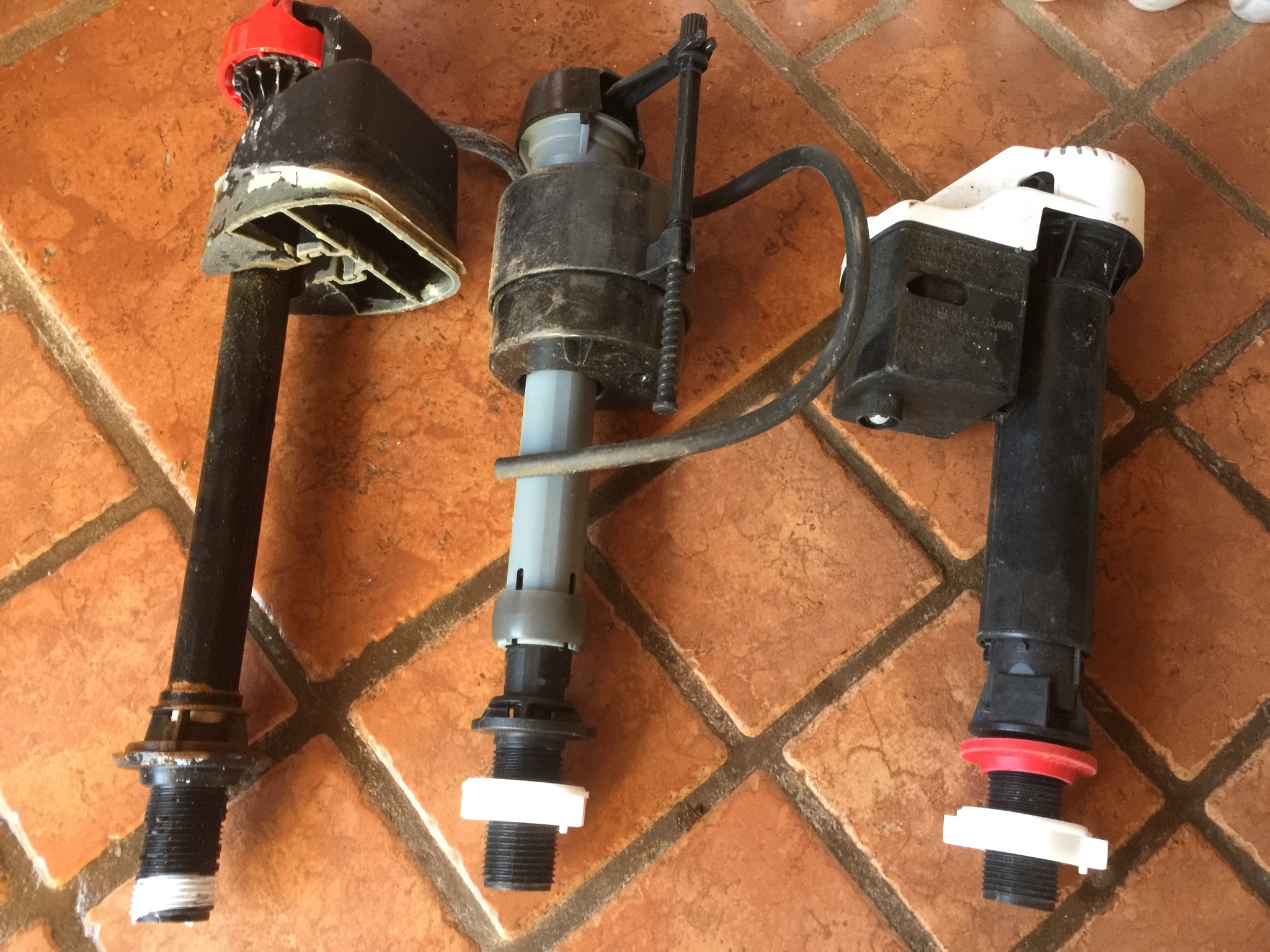
Let it be said in my defense that I wasn’t entirely wrong about that. One of these valves does at least go in the hole and allow the toilet to function. But all three spare valves are clearly made for a shallower tank. The one I installed, even with the float level cranked up as far as it will go, leaves me with a tank level an inch lower than what I want. So this will get me through till I can replace it, and that’s about the best I can say.
(Grumble) I knew it was coming, and should have been better prepared. It’s not like I haven’t had toilet failures before.
The amusing thing about the Lair’s indoor plumbing is that everything about the drainage and the septic tank and the leach field is home-made and scrounged and improvised, and I assumed going in that it would cause me big trouble if it worked at all. Instead it has worked perfectly since summer 2011. But the Lair’s multiple factory-made toilets need constant maintenance, punctuated by occasional total failure. Does that seem right to you?
















“Does that seem right to you?”
Nope . . . but it sure seems “normal”.
Did you try taking the old valve apart (assuming that is possible)? Several times when I’ve done plumbing work in this hard water gulch, one or more toilet valves started leaking because a bit of mineral deposit or other debris got across the sealing surface of the valve. Taking it apart, wiping it clean, and re-assembling saved me the 1-2 hour chore of replacing the entire valve.
I did try to take it apart but not very hard, since it involved prying plastic parts to pop other plastic parts out. That way lies broken plastic, but I’d have tried it more seriously if there hadn’t been a simpler alternative.
You may be able to reuse the old toilet valve. Make a solution of baking soda and that extra strength house cleaning vinegar you have. Then take the valve and soak it for at least three to four hours to get rid of the calcium/lime build up. 1/3 cup backing soda to 16 cups of vinegar should do it.
I’m thinking diy water filtration system for the lair — and we could fund it — what do you think? Solve going to town for water every week and solve the calcification of appliances (which I realize is probably only the toilet, but still….
I don’t know. The only effective water decalcification systems I’ve seen are reverse osmosis and salt-based water softeners. For different reasons I don’t consider either acceptable – though if I saw an RO system that didn’t require power I might change my mind.
That would be grand, because the one thing I really would like to build is a passive solar water heater, and no design I’ve seen would survive long with this much calcium.
Next time you are in a hardware or supermarket type store. look for a small jug of CLR or in a pinch, straight vinegar. Put enough of what you have into a glass container large enough for you to dunk the head of the old valve into and let it soak overnight, that should clean up a lot of the crud that is likely keeping it from working properly. The vinegar won’t do much for the rust but it does clean away the lime/calcium deposits.CLR cleans all of the deposits off and it does work. We don’t have as hard water as you do but I seem to have toilet shut-off valve issues about every 2 years or so. Come to think of it, Christmas is near, lemme see what Santa may be prepping.
There’s these things called scale control filters. Also, scale control media. Sometimes, the systems are called “salt-free” softeners, but I don’t think they actually change the hardness. Anyhoo, supposedly, these things do something to the calcium, so that it doesn’t build up. I have no idea how that works, nor whether there’s any effect on iron — if you have iron. All I know about them is that they exist. Cost to operate over time? Beats me. But it would seem to be a possible alternative to RO.
How tall is your tank? That middle one should extend up a good 2 more inches or more.
By that, I mean you slip up that gray collar at the bottom and either screw or pull it longer. slip collar back.
I’m glad I read ALL the comments first:
My question was going to be:
Did you only try adjusting the float, or did you extend the fill pipe as well. Pull gray collar up, CAREFULLY tug the two pipe sections apart. There are two (probably) o-rings in there to seal the sections together, and they can sometimes be difficult to re-insert if you accidentally pull the lower pipe all the way off.
I have very hard water here too. The major problem I have is a buildup of mineral on the lip of the drain in the bottom of the tank. It begins to leak and can waste a lot of water even if that leak is tiny. I now put a cup of straight vinegar into the tank once a month, just before I go to bed. So far, I’ve had no more leaks there, and the valve stays clean as well.
That middle float looks like a fluidmaster toilet valve and has a small gasket that can be replace if it gets crudded up. also it extends on it pole so that it will fit multiple size toilets
Yup, you guys are right. That model of valve is height-adjustable and I didn’t know it. Learn something new every other day or so. 🙂
$15.95 saved! Every once in a while your Peanut Gallery of fans comes up with a winning idea. 🙂
I’m pretty sure the one on the right twists to unlock to extend. Just had to replace a leaky one at home and it looked the same.
Center and right valves should be universal. They both can extend quite a bit.
The FLuidmaster valve is truly universal for any float type toilet.