Went into town this morning to refill my drinking water and saw this flyer on the board…
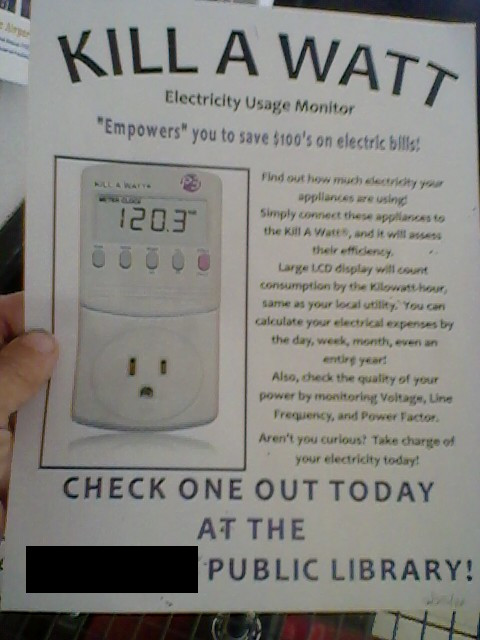
It’s been a long time since I paid attention to what purposes people put public libraries to, for obvious reasons. And a small rural town’s library may well make itself useful in ways that wouldn’t occur to one in a city. But is this a thing now? Where you can check out use-once tools from libraries?
‘Cause it’s kind of a cool idea.















For some libraries, yes. There are libraries that check out hand-tools too. Librarians are trying to expand the function of the library beyond “book repository” to more general-purpose educational and resource facility. Much of this is being driven by the fact that the Internet makes much of the traditional library services, if not quite obsolete, *seem* less useful. Why go to the library when Wikipedia is right there?
Plugging the term “Kill a watt public library” into Google, I get about 237,000 results. So yes, it must be a thing. That said, I haven’t seen any in my own library.
What surprises me about my own library is the popularity of the computers. There are dozens of them, yet it’s common to see them all busy! On the other hand, there never seems to be a traffic jam around the book shelves.
OK, but I know exactly how much electricity I use each month. It is spelled out in great detail on the power company web site on top of that. Knowing the amount used by any individual electric device in my house wouldn’t be too helpful, unless maybe I was looking to replace it. In that case, the comparison would be among the possible new devices, since most new stuff is probably going to use less electricity anyway.
Guess this could be useful to the occasional hermit, perhaps. LOL So, did you check one out?
There are several tool libraries separate from the public library system in my city. The public library checks out e-books, audio books, wifi hotspots, museum passes, access to varies online databases (like All Data for auto repair info), in addition to regular books and reference librarian services.
Oh, heck no. I’ve got one. Kill-a-watts are extremely useful off-grid.
Mama, the point is to discover if you have any particular individual device using an inordinate amount of electricity . . . which might lead you to research similar new devices to obtain a more efficient replacement. It’s a way of discovering what you don’t know you don’t know.
🙂
Sure, Kentucky, but I can’t imagine many people being willing or able to junk something that’s still working to buy something new. As I said, if I was already looking to buy new, I’d look at the energy usage of the new stuff instead, but that’s just me. I certainly don’t have the money to replace things just because they use more electricity. But nothing in this house is old enough to use an “inordinate amount,” whatever that is. 🙂 My last electric bill, for one of the coldest months of the year, was $87. And I have electric heat. 🙂
I’m sure some people would find this useful, but it just seems like more pressure to be “green.” Where did these devices come from, and who pays for them?
They are readily available . . . and relatively inexpensive . . .
http://www.p3international.com/products/P4400.html
How the library came by them I have no idea, any more than I know who pays for the publicly-accessible computers and other tools they offer.
They merely provide a way to monitor one’s expenses. If you don’t see a need to know this info, by all means don’t look into this. It’s a curiosity thing, at least. The only pressure involved is that which one might impose on oneself . . . and I’m immune.
😉