I suppose I should name the other two Rhode Island Reds, since it seems I’m going to be writing about them. Let’s call them Middle Chicken (MC) and Littlest Chicken (LC) and leave it at that. Proper names belong to animals with personalities, and I assure you your average chicken has the personality of a chicken. Agnes has a personality. Upgrayedd had (past tense) a personality. Unpleasant personalities perhaps. But personalities nonetheless. Most chickens are just chickens and will be treated accordingly. Seriously, it would be like naming field mice. First you must be able to tell them apart.
But no, I refuse to go to the trouble of photographs. Photographs are a pain. I have to go out in the cold, get the chicken to pose (try it!), shoot the photo, take the mem card out of the camera, dig around and plug in the old laptop, Gimp the photo into submission, load it onto a thumb drive, transfer the thumb drive to the working laptop, shut down, disconnect and store the old laptop…for a picture of a chicken? I don’t think so. You’ve seen a chicken. They all look exactly like these…
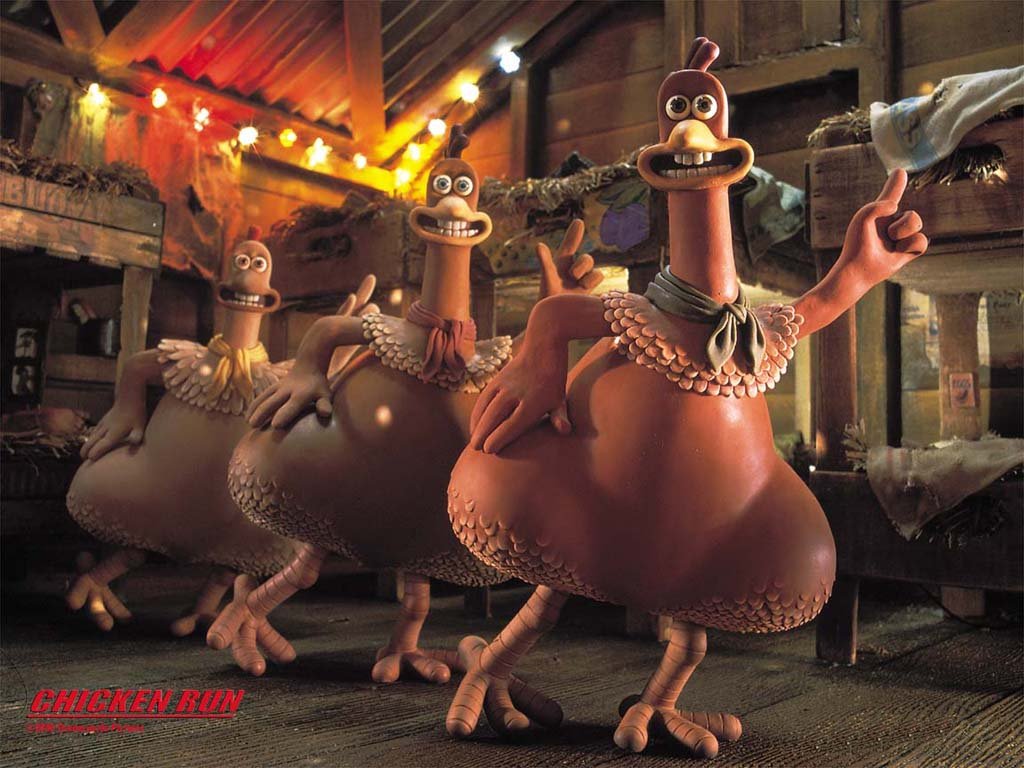
There now. May I proceed with my story? Please? Thank you.
(ahem) Anyway, as I was saying…
MC and LC would probably not appreciate knowing that Agnes, a mile away, has given away the show. All three have grown lovely new suits of feathers (Even LC mostly recovered (heh) from her plucking and flaying at the beak of Agnes the Red, Terror of the Chicken House) and I would have thought having done so, they could find it in their cloacas to get back to business. But this is the first serious molt I’ve ever seen, so I don’t have more than a general idea of what the rules are.
Landlady and I have discussed possible explanations for the Brahmas’ continued reluctance to lay us some damned eggs. The general consensus is that they’re big birds and it takes a long time for the poor dears to come on line. I suggested that maybe part of the problem is that the Big Chickenhouse is quite dark during the day, and they need more light. In fact I still think that might be true.
Heaven help her, Landlady acted on my suggestion and brought up the means to correct that deficiency: A work light, a bright (and no doubt expensive) LED bulb, and a package containing two electric timers. I unpackaged and strung all this (except for the spare timer) together, and presto! The Brahmas have sixteen hours of light in their house whether they want it or not. It didn’t have a dramatic effect on their egg production, I do confess.
Then one day Agnes the Red, who has long-since feathered out, laid a big beautiful egg. She’s been laying an egg a day ever since. And it occurred to me that if Agnes could do it, nothing stopped the other two mature RIR hens from doing it, too. Obstinacy, perhaps?
Or maybe it was a change of habit? See, when all three RIRs were together they spent virtually all day outdoors in the sunshine. They only used their coop for sleeping and nesting. But since the Great Flaying Incident of early November MC and LC spend most of their time inside the coop. I don’t know why, but I do notice it’s rather dark in there. And it is the darkest part of the year.
I’d been pondering what I could do about that when Geiger Counter Guy and I had a conversation about Christmas lights. Long-time readers know Uncle (Bah Humbug) Joel doesn’t have a lot to do with Christmas, though since becoming a cedar bum he is a bit more hypocritical about accepting gifts and dinner invitations than he used to be. So Christmas lights are not something that occupy a large part of my thinking.
But GC Guy has this thing about LEDs. He finds them diverting, he has made a hobby of discovering what new power-saving uses they can be put to. And in the course of our conversation he pointed out that a small string of LED Christmas lights requires 2.4 watts, or a mere 0.02 amps, to run – and that string produces a respectable amount of area light. Not enough to read by, certainly. But enough to light the interior of a small chicken coop?
Chickens can’t read, after all.
Hm. Even with my free sample of an electrical system, even with a dead cell in a damaged battery, I can afford two/hundredths of an amp. Particularly if it doesn’t run all night.
Hm.
Visions of that second electrical timer, gathering copious dust on a shelf in Landlady’s Big Chickenhouse, shall we say, danced in my head.
They sell small strings of LED Christmas lights at the dollar store. I know this because I wrote a note to myself to look, next time I was there. Then I brought one home.
Extension cord. Timer. Christmas lights. Duct tape. And presto! From eight in the morning to ten at night, MC and LC can sit in the chicken coop all they want, but they can’t sit in the dark.
And we’ll see if that has any effect on their output.













I have a request, if you’re up to a project. With our solar/electric system, things like plug in timers run funny. During peak input when the batteries are nicely charged, timers and clocks run faster, so every day they gain a bit of time. Since your system is smaller, I’d be interested to know if this happens to you, too, or if this is some abnormal peculiarity of our system. Meanwhile, wish MC and LC a Merry Christmas outside the stew pot. 😉
I will pay attention to that and try to remember to report back CH. But question: Are you using electromechanical timers that actually rotate? Because these that we’re using here are electronic, and that might give different results.
Yup. We’ve got(had) the old old turning face kind that rotate. It also happened with clocks, both digital and the kinds with hands that go around. But the computer’s atomic clock does perfectly fine and the time on the phone stays where it belongs. Anyway, it’ll be fun/interesting to get your input if you do think of it.
Mozart. The chickens want Mozart. They told me so. Mono will suffice. Not too loud.
-s
I used to raise chickens, and I encountered the “won’t lay in darkest winter” issue as well. A red heat lamp (250 watts) got ’em laying in no time. I’ll be interested to learn if the Christmas lights will work just as well for a fraction of the energy usage. Good luck.
I could arrange Mozart. If they decide they want Nirvana, I’ll show them a different sort of Presto.
The need for heat lamps is the one thing that will prevent me from ever raising my own chicks. I know my wattage limits.
“The need for heat lamps is the one thing that will prevent me from ever raising my own chicks. I know my wattage limits.”
A friend of mine showed me a trick where he built a long box (guessing about 4′ long x 2′ wide x 18″ tall) for his chicks (about a dozen IIRC), with about 1/3 of one end covered, and a ‘curtain’ hanging down to within about 2″ of the floor/litter. In one corner of this sectioned off area he placed a 40w incandescent bulb. With such a small area, it provided plenty of heat for his chicks, and if they got too warm they simply went ‘outside’. Most of the time they were they were sprawled contentedly on the opposite side of ‘the room’ from the light though.
Now, I understand that 40w on a fixed power budget is still a bit of a cost…but it’s not a 250w heat lamp!