It’s the first of the month, which makes it Battery Day at the Gulch. I thought, since I’ve got this good camera now, I’d take a moment and express some of our community battery guy’s pet peeves. If you plan to set up an off-grid electrical system, you can save yourself hours of aggravation just by the way you lay out your storage batteries.

This is the entrance to Ian’s powershed, which is cool because underground. Why is underground cool? I don’t know. Do we need a reason?

Ian’s battery bank is my favorite. The box opens completely at the top, it’s not too deep, and – since I scrounged a fluorescent lamp which was very easy to hang on the exposed beams – it’s well-lit.
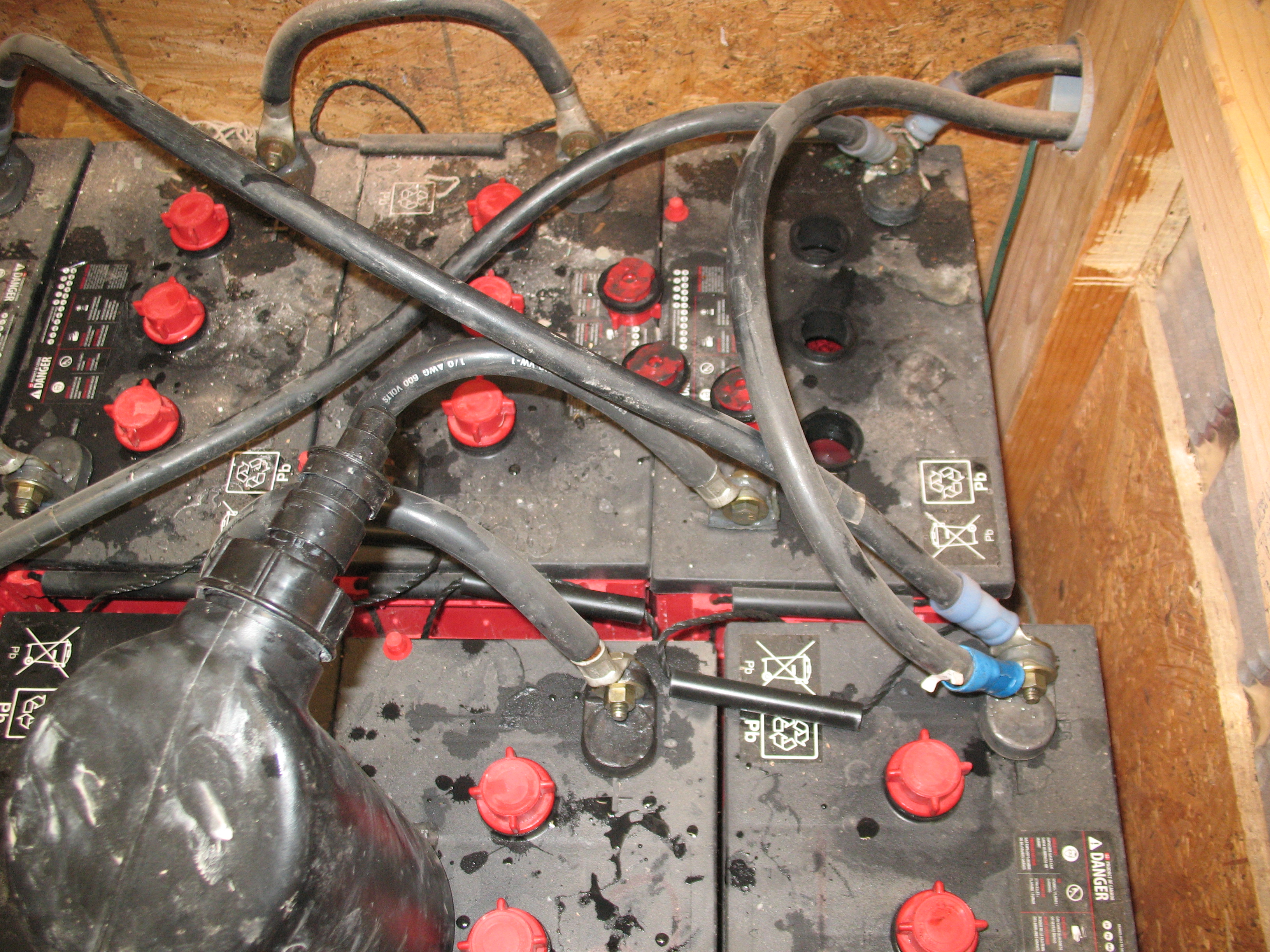
Most of the filler caps are exposed, not obstructed by cables. Some do the other thing. This seems like a minor consideration until you actually have to deal with it. Seriously, you can save yourself a lot of aggravation simply by routing your cables to leave your filler caps as unobstructed as possible.

This is J&H’s powershed. J was very concerned about freeze prevention when he laid it out – it also contains his pressure pump and tank – and it’s very heavily insulated in every direction. And so it’s cramped and uncomfortable to work in.

J was very concerned about battery fumes, so his box is almost sealed except for the exhaust pipe to the outside. Damned if I’ve ever been able to identify an air inlet, though. I don’t believe that exhaust pipe is doing anything.

…and I think it’s as a result of that that his batteries – which are only a couple of years old – are a real mess. The batteries outgas but the vapor doesn’t have anywhere to go, so it just condenses back on the batteries. I need to get in there with some water and baking soda and clean them off. I hate that job.
Also there’s no light in there, so I have to do the whole job with a flashlight in my teeth.

The batteries for his smaller auxiliary system don’t have that problem. Of course they’re not doing anything at present, so they don’t outgas much. But this box is better ventilated. The only complaint I have here is that they’re so low. A raised platform would be easier on your back.
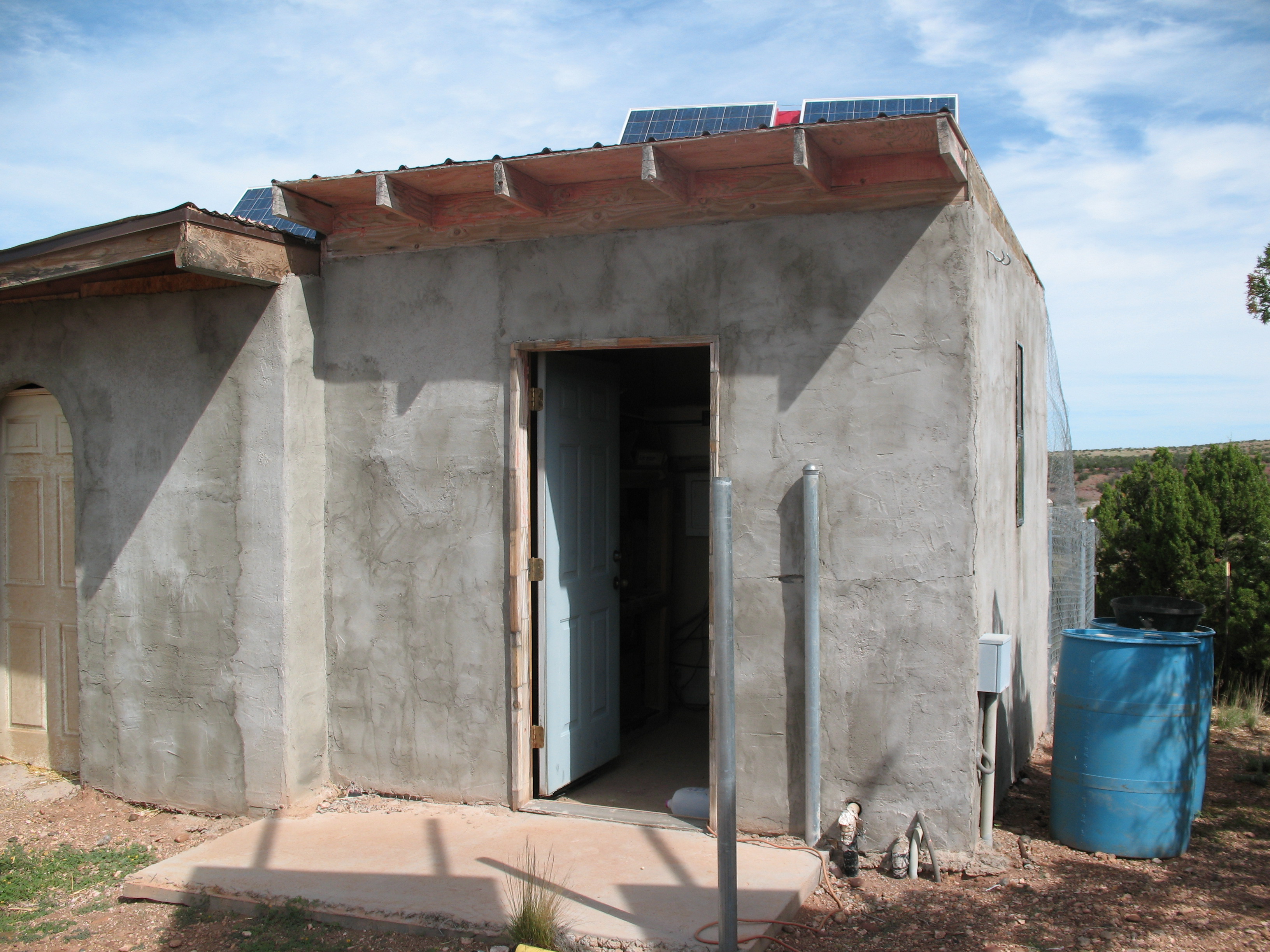
This is Landlady’s powershed.

The rack for Landlady’s batteries is the bane of my existence. It’s nobody’s fault, really. The racks were originally made for AGM batteries which were not nearly so tall and didn’t permit maintenance. These Rolls Surrette batteries are far superior but taller and do need maintenance, and the rack doesn’t make that easy. If you can build your batteries a ventilated box that exhausts to the outdoors, and that opens to expose the battery tops, and if you route your cables to keep the caps as obstruction-free as possible, your life will be much simpler. If you keep the job simple, you’re a lot less likely to put it off. Regular battery maintenance will help a great deal in promoting longer battery life.

Of course it’s easy to overthink all this… 🙂
But while an open table works for me, there’s definitely something to be said for enclosing your batteries in a box. Even in my far-from-airtight powershed, fumes are sometimes an issue. And when the winter gets particularly cold, I wrap my batteries in fiberglass insulation because lead-acid batteries will freeze in extreme cold – especially if they’re discharged. Outgassing batteries enclosed in a box will heat their own enclosure.















Re Ian’s battery bunker, er, storage: my immediate thought was the curved wall would deflect the pressure wave from the blast. See what sleep deprivation does to the alleged thought process?
Good tips, Joel. I will think of your post if I ever get around to doing the things I shoulda done a long time ago.
I was told by a battery/solar “expert” once that one way to protect your batteries in real cold weather was to keep a load on them. I know it works for me in cold weather but don’t know about batteries.
I think I see what you did there, Tahn. 🙂
There are two ways to think about it. Fully-charged batteries are less likely to freeze because their electrolyte’s specific gravity is high. But they will freeze in extreme cold. Enclosed batteries that are under load and discharging produce heat, which will warm their enclosure.
I hope we can count on a similar battery post from you on the first of each and every month. You just reminded me to go water my batteries.
So, how does one properly vent a battery box and prevent the batteries from freezing? I’m assuming the venting isn’t powered but dependent upon convection; I’d guess venting using a vertical black plastic pipe on the exterior of the south face of whatever structure the batteries are in would aid in convection, and the circulation loop could be closed by placing the intake vent inside the structure near the roof, assuming the structure is adequately vented there. Is there some sort of thermal shutoff to the vent that closes at
+/- 32F? (or, should there be?). How much venting is necessary?
And, since batteries work better warm than cold, is it practical to add some sort of air-based solar collector to keep them in the 75-80F range?
Nosmo, I don’t know of anyone who goes to that much trouble. Battery freeze isn’t a big issue as long as the batteries aren’t discharged – a layer of insulation is enough at 20o below. As for venting, yeah: An inlet near the bottom of the box and a 1 1/2″ ABS pipe out the top will do the trick. I’ve never seen active venting used, though it might be standard in really big installations.
Thanks for this Joel,
I’d seen a pic you posted (I think it was you) of a config like Landlady’s, or another very similar and liked how it allowed for a large number of batteries with very little space consumed. I never thought about the maintenance on the batteries in that configuration though.
This guy did nice work on an off grid cabin in Northern Michigan (some early posts below)
(https://offgridcabin.wordpress.com/2011/01/15/early-days-12-batteries/)
(https://offgridcabin.wordpress.com/2011/01/15/pv-system-the-panels-ii/)
After reading your post on maintenance, it makes a lot more sense how he laid out the batteries.
Well, you seem to have a pile of decent scrap lumber, and perhaps enough spare time to cobble
something together – maybe you can improve landlady’s arrangement? A tray that is suspended so you can swing it out from underneath? (presuming that the wires will reach, or can be loosened) I was thinking along the lines of porch glider sort of arrangement – with a parallelogram of wood and pivot points so the batteries would never tip, and easy to prop into service position, then back to normally stowed position. Might take a little fiddling.
Gotta remember Max, those batteries are anything but light…