Wasn’t planning to drink it, that’s for sure.
I’ve got six level points in space I need to determine, all by myself. The only way I know how to do that is with a water level. So I bought 20′ of 3/8″ clear tube and a packet of cherry Kool-aid. (Sugarless because it’s cheaper and because sugar will drive the frickin’ packrats crazy and you may as well just feed them the tube afterward. Damn packrats.) That makes the level at the other end a lot easier to see from 10 feet away.
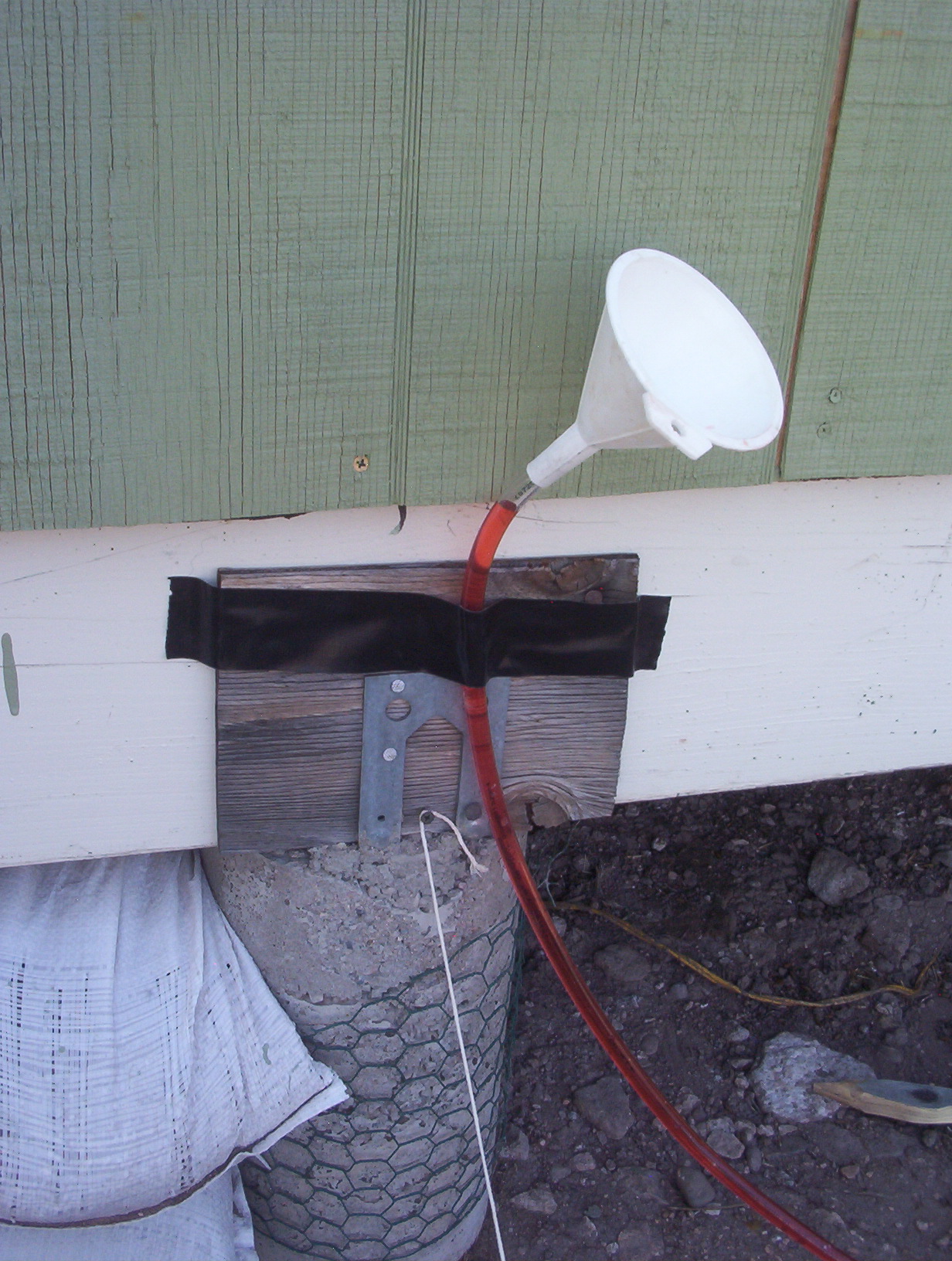
There are better ways to fill the tube, but when you’re working alone one end will always be falling into the dirt and draining and generally trying to make your life hell. So in this case I shoved one end into a funnel and taped it over the spot I wanted to use as my reference point.
Then I taped the other end to a length of old conduit and carefully lined the conduit up with rebar at each pier site.
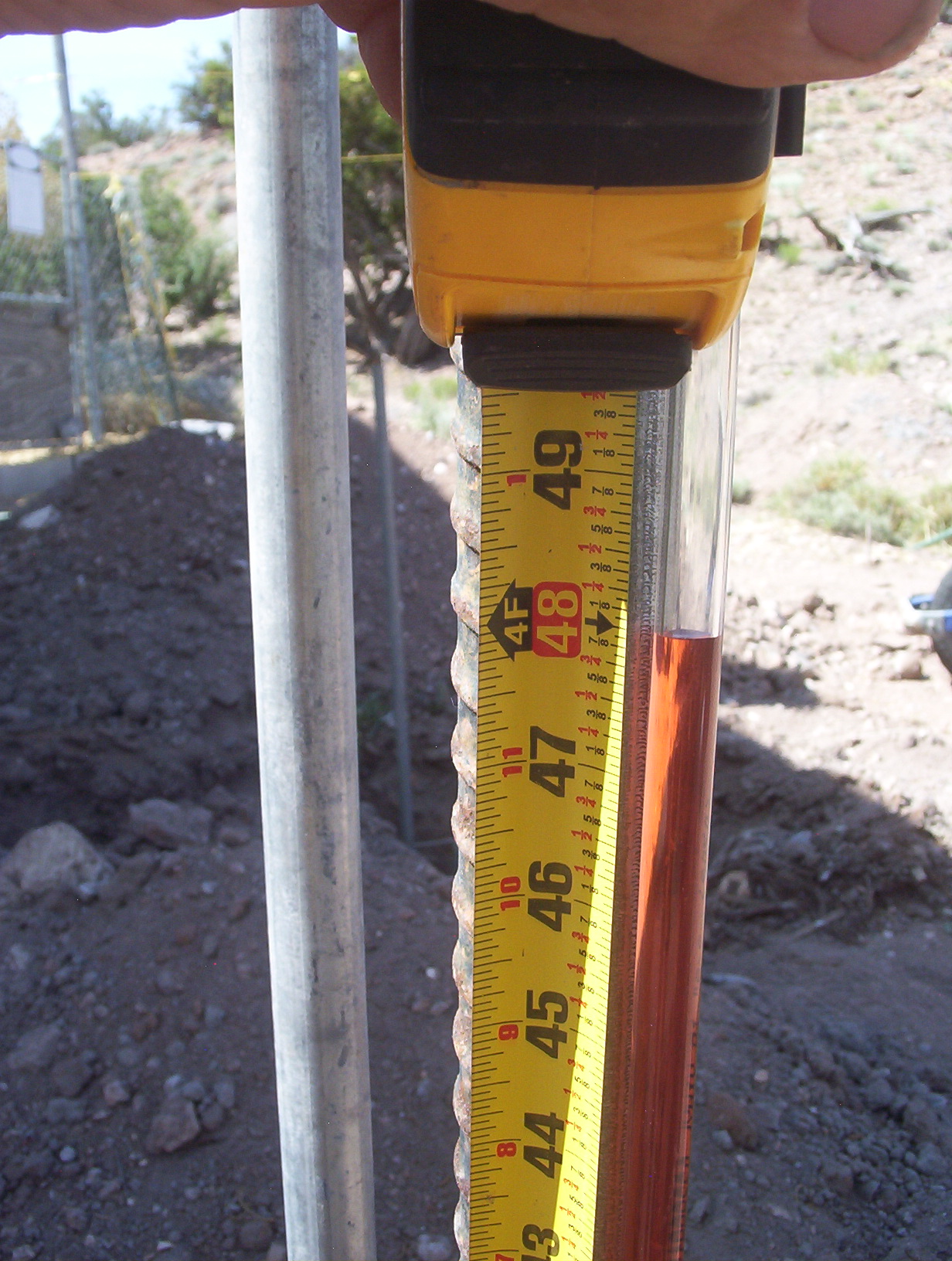
It’s a pain in the ass working it alone but this will get you remarkably precise measurements of a point in open space. In this case that’s the point at which I want the top of the floor joist to end up, so I have to subtract the width of the joist and then I know how high to pour each pier.
Earlier this morning I cut sections for building the forms, and now with just a little more arithmetic I’ll know exactly how long to build each form.















That is very clever! Learn something new all the time.
When you are done with the project, save that tubing for use as a gas manometer.
🙂 Funny you should mention that. Many years ago I used smaller clear tubing, a piece of wood and some tape to build a manometer to measure crankcase pressure on Oldsmobile 5.7L diesels, which notoriously wore through their piston rings at about 45,000 miles. It was a go/no go gauge: Two inches of water displacement indicated excessive pressure requiring a new short block. Thing cost about a buck, and over the few years I used it I generated many thousand dollars profit for the dealership in a procedure taking seconds.
I never heard of such a thing, that’s pretty smart.
I watched a History Channel show on how the archaeologists think the ancient Egyptians leveled the ground for the base of the pyramids. I wonder…….
I inherited a water level from my dad. Graduated cylinders joined by the clear hose. Used it to lay out the deck out back. Wish I’d thought of the Kool Aid trick.
I have a similar setup for syncing carbs on multicylinder bikes. I don’t care how much vacuum they’re drawing, only that they’re equal. 4 pieces of tubing attached to a 1x12x48″, each length with 6′ free to run to the carbs (or, rather, to the vacuum ports). I can hang or stand it within easy view, & it’s full of ATF, for the visibility.
My great-uncle was a man of many talents.
He was involved in a construction project back in the 30s. The culmination of the project were two very long but narrow fountains at the front of a building. They were designed so that the water would cascade down over the walls of the fountains from the long narrow pools contained by their walls.
His crew built one fountain. Another crew built the other.
My great-uncle had little formal education.
The other crew was led by a fellow with a degree in engineering.
When the fountains were filled the water coursed perfectly down the walls of the fountain that my great-uncle had built. The water in the other fountain only ran over the narrow endwalls of the other fountain.
My uneducated Okie great-uncle had used a water level in constructing his fountain.
The engineer used an optical level utilizing line of sight.
The fountains were of such length the the curvature of the earth became a factor, and the water level followed the curvature of the earth whilst the perfectly straight line of sight optical level did not, so the water only ran over the ends of that fountain.
Joel, this is fascinating. As a younger person with an interest in this sort of thing but no formal education in building or on-the-job training this is the sort of thing I’ll file away for future use. Thank you!
In a pinch, you can do this with a garden hose, but it’s a little messier.
Use KoolAid with sugar in it, and add a little poison. When the rats come for it you’ll deplete the rat population and have everything level.
I’ve read about water levels, never built or used one, but I have a project to do where the water level idea is perfect.
Waepenedmann, love your story.
The people who read this blog and Joel have so much practical useful knowledge that a lot of us never learned…
Yes, Zelda,
I, too, am entirely impressed with the practical engineering I learn here. Wonderful lessons!
But, don’t poison the koolaid or the rats. Because the eagles and hawks might eat the rats. Or the beats might be eaten by other creatures we’d just as soon keep around. I think the only way is trapping or shooting (or spearing them) then offering their carcasses to the sky gods or the sand gods. 🙂 For those who would eat rats are your friends. 🙂
**
ff
Not to worry. I don’t use poison, both for fear of killing things that like to eat rats – dogs, for example – and because I don’t like the smell of rotting rodents that go into the walls to die.