I have a rule, and it has helped me maintain joie de vivre under sometimes challenging circumstances: Don’t be afraid of making bonehead mistakes, they’re preferable to a lack of action caused by analysis paralysis. But do try to learn from the bonehead mistakes of yourself and others whenever practical.
Two things consumed the morning, in the spirit of the above aphorism. First, a new rule: Stop bad-mouthing gasoline generators, Joel.
Okay, in my own defense I only ever badmouthed crappy gasoline generators, but since that’s the only kind I could ever contemplate owning I just arranged my affairs so I could always live without one.
Now that I unexpectedly find myself the owner of a good portable generator, I’m in love.
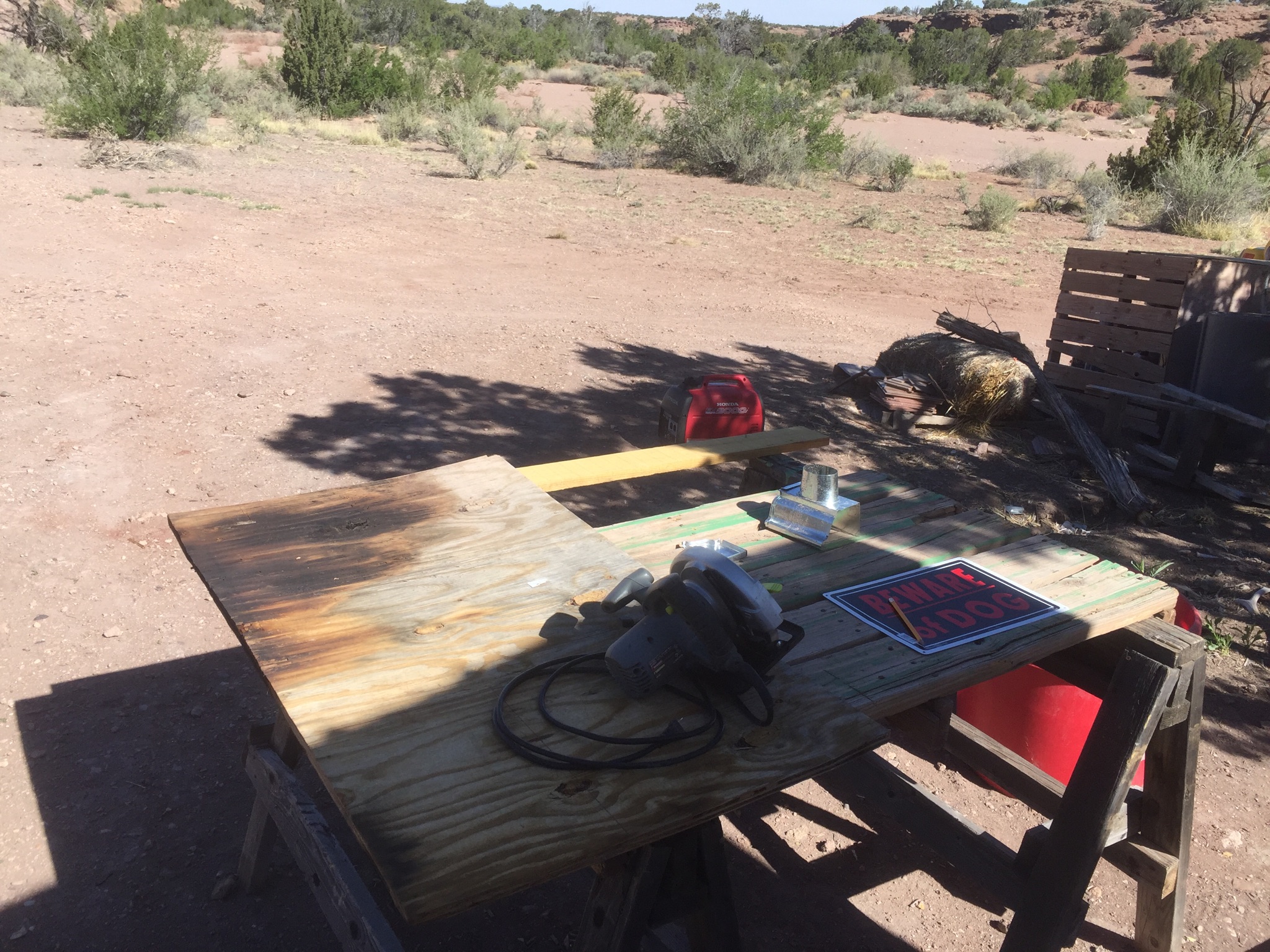
Ever since the Great Lightning Strike of 2015, I’ve been limited to using my circular saw only at Ian’s or Landlady’s places. My new free inverter won’t run the saw – and my tiny battery bank would never run it long anyway, and only in sunny weather.
But since the kind and incredibly generous donation of a Honda inverter generator, I can run any damn power tool as long as I want, in all weathers. I wanted to cut a piece of scrap 3/4″ plywood for the new Beware of Big Black Hairy Lazy Dog sign first thing this morning, and normally that would have involved a great many irritating work-arounds. Instead I could just haul the Honda out of the powershed and have at it.

While I was at it, and since I have a handful of carriage bolts lying around from a project of last year that took a left turn, I decided to seriously bolt that sucker to the newly (and much more seriously) planted signpost that that stupid cow knocked over last winter.

Cow or no cow that sign wasn’t constructed very sturdily and was going to fly apart in a windstorm someday soon anyway. So in the end it’s probably for the best.

While I have everything out I need to cut a new backing for the other road sign as well. Right after lunch and before I put the tools away, which I need to get to because I think the promised rain isn’t going to wait for tomorrow (as promised.)
But having finished that little sign project, it was time to get to the real scheduled burden of the morning…
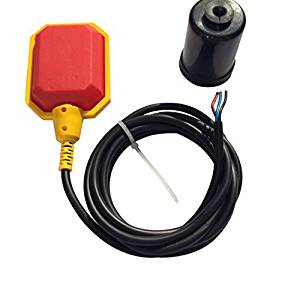
…installing a new float switch in Ian’s water tank.
I am not an electrician. Electrical projects intimidate me on general principles, and I tend to procrastinate. But it’s easier to contemplate when I know nothing I do can make things worse. All winter I’ve been manually checking the tank level and turning the pump on when it got low, otherwise just leaving it off. I seriously contemplated never replacing the switch at all. But that’s bad practice, especially since it turns out the part is easily acquired and not very expensive.
And how hard can it be, right? It’s just three wires. Easy Peasy.
Uh huh.
Okay, so I unpackaged the switch (I forgot to take a picture of this) and immediately began to lose confidence: There were parts included that made no immediate sense, and almost no written instructions at all. The closest thing to instructions were a couple of very non-detailed pictures captioned in Spanish. I was going to have to wing it, but the pictures made one thing clear: There were three wires and I was supposed to only connect two of them, depending on whether the switch was supposed to be normally-on or normally-off. That was an unexpected complication…

…the old switch also had three wires, and Ian had connected them all.
Uh? This is an (externally, at least) identical switch! Am I to understand, right from the git, that the extremely sparse and multicultural instructions are wrong?
It took me a while to recall something very important about the original installation: Ian’s not an electrician, either. He’s a thoroughly eclectic expert on French battle rifles and forgotten weapons in general, but he doesn’t know any more about wiring water tank float switches than I do. And I’m making it up as I go along. So let’s assume that the instructions are right and Ian’s wrong.
That assumption worked pretty well, as it turns out. He did wire up all three switch leads, but one of the wires he wired them to didn’t go anywhere.
So now I had two leads to connect to three possible other wires, and there was a certain amount of “try different combinations until the pump runs.” But soon I found a combination where the pump runs when the switch is down and stops running when it’s up, and that’s what we wanted. In addition to buying the new switch I also dropped a couple of dollars on a sealed connection kit…

…and that should keep some subterranean problems from recurring.
But before I could do all that I had to solve another unexpected problem…

Ian ran the switch cable down through the overflow pipe, and even though I can’t believe that’s right I went ahead and did the same thing because … where the hell else are you supposed to put it? There’s no apparent provision on the tank for a float switch that doesn’t involve running it down through that pipe. But when I tried to run the new cable down the pipe, it wouldn’t go. I held it up to the sky to see if there was an obstruction, and could see no daylight.
Turns out it was clogged – not with mud, but with calcium condensed from all the water that had overflowed and then evaporated in that pipe.

Yeah. We’ve got really hard well water. This is why the only people in the neighborhood with hot running water also have elaborate and expensive water softening systems. It’s not as simple as just rigging a water heater: Anything remotely like a restriction, and especially anything involving hot water, will eventually clog. We’re at high altitude: Water boils at less than 200o F. Even without hot water your average garden sprayer lasts a single season. Water heaters don’t last that long.
So anyway, Ian ran that pipe down under the sand but I didn’t see any advantage to doing that. The water soaked into the sand and then left its calcium behind as it slowly evaporated. So I took the pipe home and cut it shorter so it terminates just above the sand.
And by the way – you wanna see something cool?

Big Brother sent me one of these B&D recip saws a couple of years ago. As a proof of concept (the concept being “you need one of these”) it was a complete success but as the actual saw I needed it was underbuilt and underpowered. I replaced it with a bigger, badder corded saw which – to my pleased surprise – my inverter will actually run. I use it mostly for cutting up pallets in a step toward converting them to firewood.
That cordless saw is still damned useful, given the relative rarity of electrical outlets around here. But having used it on firewood for a season it was already on its way to being worn out. Not broken, by any means, but prone to overheat easily and sometimes you can hear unhappy bearings. I should just have saved it for light duty use. Turns out Big Brother bought himself one around the time he bought mine, but doesn’t use it nearly as much as I do. So in his recent visit he brought his along and then swapped it for my older one. Isn’t that cool?
Anyway – the water tank float switch is fixed, though it might still need a bit of adjustment. The one I bought came with a weight that goes on the cable, and should solve the old problem I had with the original that it tended to turn itself around and get stuck in a tank crease and then not switch off. That weight slides on the cable, and looks like once I have it adjusted there should be no more problem. So I’m letting the pump run, and we’ll see how it goes.
Meanwhile it looks like the weather is going to hell twelve hours ahead of schedule, so I need to eat lunch, do a couple of little things, and then put tools away for the day.















Assuming you recorded which color wire connects to what color wire, it might be useful to create some documentation: switch mfg name, model, part number, who locally/regionally/nationally/galactically carries it, contact info for the mfg (models of anything get changed frequently these days, and a tech resource is often useful), how it gets connected, tested, etc., then store the documentation where it can be found.
That sort of stuff usually comes naturally to us anal and OCD types, but every time I’ve skipped it, I find myself 12-24 months later wasting half a day restarting from zero to figure out what I did the last time I tackled that job.
Honda makes good generators. And that one – the inverter – can run electronics as well as power tools.
BUT I suggest a good collection of hand tools. Japanese saws are usually recommended. Europeans have been doing things backwards for all time. 240 mm ryoba for general sawing is the basic recommendation to start. (It is the double-sided saw you see everywhere.) Not all saws are created equal.) They make bigger saws if you are sawing bigger stuff. The draw action makes it much easier to hold a straight line. Or so I’ve found. I have trimmed the end off laminate counter-tops and had no problems.
For precise cuts I don’t like the Japanese dozuki. Get a decent back saw. These are traditionally for doing fine cabinet work, like cutting dovetails, but for anything that needs a light touch… They can be spendy.
I also have a set of hand-planes, though I am still looking for some more. New they can be expensive. Decent chisels. And I need a hand-brace. Maybe more than 1. Still researching.
I figure if the power goes out for a good long time, then I still want to be able to fix stuff. And some of the tools do a better job with less setup than than a power rig. Power tools are great for repetitive stuff. Making 4 table legs exactly the same length, etc.
A multimeter (cheapo $5 is fine) is invaluable for figuring out how to wire switches correctly. Set it to continuity mode (beeps when the probes are touches), clip it to your wires, and figure out which combination is shorted when the switch is in the “on” position (and just as importantly, aren’t connected when it’s “off”). Saves a lot of trial and error.
Now that you’ve cut that overflow pipe short of the ground, is there any worry of a rat chewing on that now-exposed switch cable that I presume comes up from underground?
Possibility, always. But it’s unlikely. I get chewed cables in places where rats like to hide. This one’s out in the open and has no shelter to attract them.
Couple things:
Since you use your generator infrequently, next time you are in town get some Pri-G (or StaBil is more common but Pri-G is better) and use it in every tank of gas. Trust me, worth the few cents per tank it will cause you.
Is YOUR Ian, The Ian of Forgotten Weapons?
I have used Sta-Bil for many years, and it has let me down. Probably would have worked okay in a float carb, but it turns out to be a mistake to trust to it too much in a chainsaw. The experience left me paranoid.
The last thing I want is to harm the carb in that lovely little engine with bad gas. So I do put Sta-Bil in the 2-gallon can I keep for the generator. But when I know I’m not going to use the generator for a while – or when it’s just turning out that way – I empty the tank, empty the carb bowl – the Honda has a very handy valve for that, the only engine I know that does – and start it until it runs dry.
And yeah, it’s that Ian. We’ve known each other going on 20 years. You could fairly say I knew him before he was (so widely known to be) cool.
That 2000i is a fantastic little gen. I have hundreds and hundreds of hours on mine I use it for the last 2% of my battery charging just to save hours (and fuel) on my diesel. I also like that you can just run them dry with no issues. We have it figured out that 1.5 yogurt containers of gas runs the entertainment system for the length of a movie then saves me the walk in the dark to the power shed because the I let it run dry. Don’t try it with a diesel.