When we disassembled Landlady’s barn in the city back in 2007, there was a whole bunch of rigid electrical conduit that for years after we rebuilt it was just a jumble of stuff in the attic. We only finished one side of the barn, the other doesn’t even have solid floor much less electricity.
But the time has come to change that, so I’ve been learning to work with wire in conduit. And as with most unfamiliar things, it’s not rocket science but hasn’t proven quite as simple as it looks.
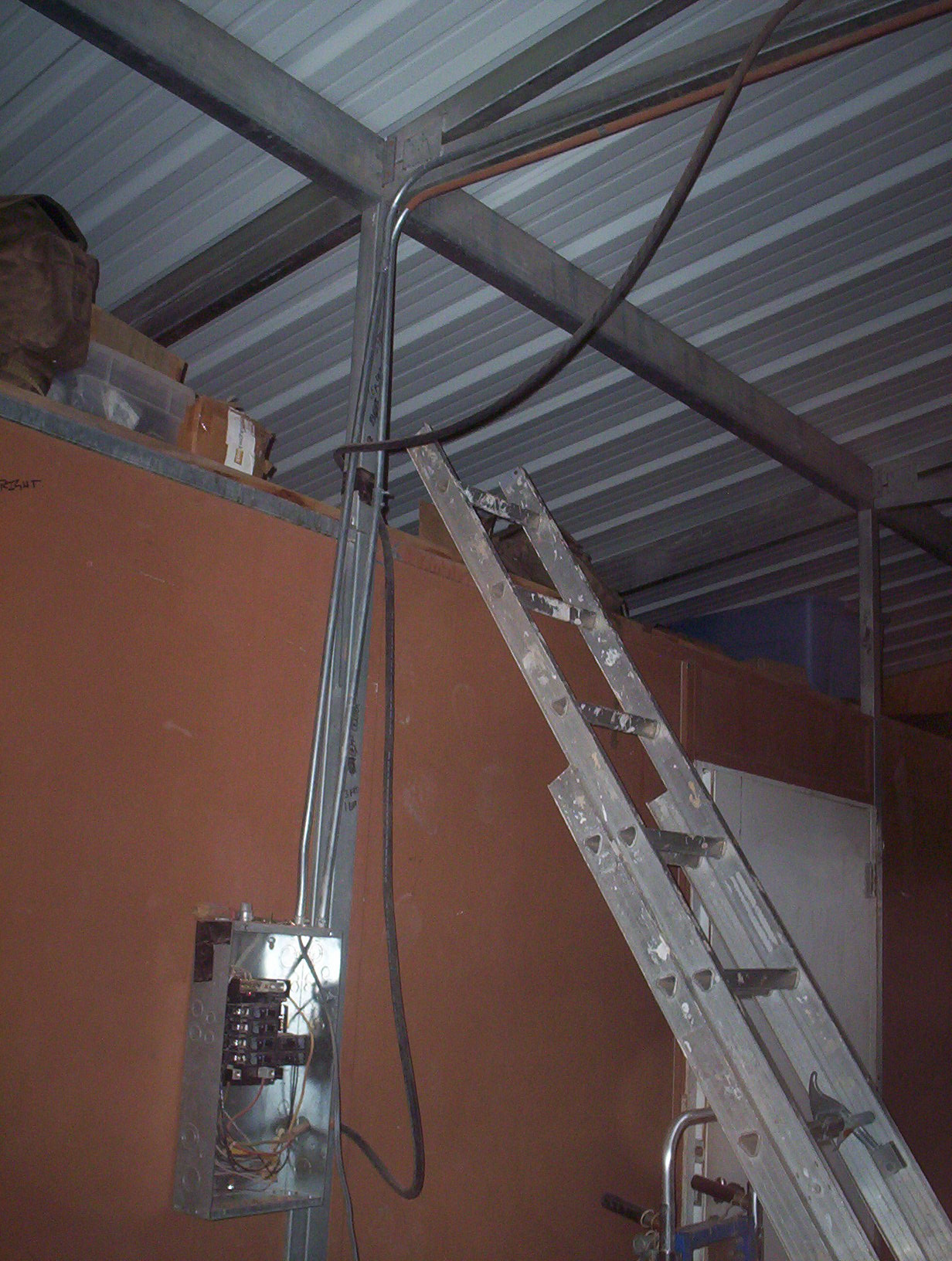 I asked for Landlady to bring single wire, but all the hardware store she went to had was Romex so I’m making due with that. I already knew Romex isn’t really made to be pulled through conduit, but since it’s only 14/2 wire it’s not giving me a big problem. Unfortunately I was reminded too late that the longest single pull, from the outside to the breaker box, requires 3 hot wires instead of two so there’s a little more improvisation than I’d planned. I had to undo some work I thought was already well done. Nothing I can’t handle. I hope.
 That big loopy cable is what we “temporarily” strung up there to feed power to the box – eight years ago. Landlady wants something at least a little less redneck, and she will have it. Except I’m going to have to use one of its conductors. So now, having hung and secured the major portion of the barn’s conduit, in the morning I’ll shut off the power, disconnect and pull down the big cable, and then cut it out of the circuit except for one of its conductors which I’ll pull through the conduit with the fish tape along with the new Romex. Then I’ll connect the Romex to the other conductors in the box outside the barn, and connect the whole thing to the breaker box.
I’m pretty sure it’ll work. If you see a big column of smoke to the west tomorrow, though, the answer is no. You can’t have my stuff.















Why 3 hot legs? I can not imagine you are putting 3 phase in the barn?
His inverter is 240 single phase, so he needs to run two hot wires, a neutral, and a ground. No, conduit is not an acceptable ground, although plenty of hillbilly electricians use it that way. Those are the same ones you read about getting electrocuted in their showers.
It is a desert, right? It gets hot pretty regularly, right? If you plan for a maximum outdoor temperature of 104 F, you should only put 12.3 amps through 2 or 3 14 AWG conductors inside a conduit. If you want to be conservative and plan for 105 to 113 maximum temperatures (I don’t know what kind of oven effect you get inside that barn) limit the current to 10.6 amps. That’s a tad over 1200 watts on a 120 volt circuit, barely 2500 on a 240 circuit. I thought landlady’s system was over 3600 watts, particularly when the generator is running.
Then there is voltage drop, always an issue on off-grid systems. How long is that run?
Sure, you can put more current through the wire, although we haven’t considered voltage drop yet. But those wires will get hot, the insulation will get soft, and it will already be scuffed and damaged because Romex shouldn’t be pulled through conduit. Conduit-grade wire is made of tougher stuff.
So you end up with a hot wire touching that conduit, which it sounds like is supposed to be your ground, but if it isn’t, you have a lethal threat waiting for someone to touch it.
Maybe don’t cut that cable down just yet. Just because the wires are hidden doesn’t make it less redneck.
An example of voltage drop: typically it is limited to 2% at maximum current. Remember, that means that 4% of the power is going to heating up those wires. Raise the voltage drop to 3%, and your power losses are 6%. That’s 1/16 of all that lovingly stored solar/battery power wasted as heat.
To keep the voltage drop on a 120 volt circuit below 2% carrying 15 amps for 100 feet requires 8 AWG wire. Using 10 AWG gives a 2.5% drop. 12 AWG is 4% voltage drop, and definitely not a good idea.
Wire gets expensive, but this is one place where going cheap can be a very, very bad idea.
How long is the run, and what is the largest 120 volt load you want to support?
Electrical wholesalers carry a lubricant specifically for wire pulling. Much useful. Also, larger diameter conduit makes the job easier and doesn’t add much to the cost.
Larger diameter ells (conduit turns) would also make for easier future wire pulling if / when wire needs replacing.
Joel: what S said. Bigger is better. And safer.
I’m working with what I’ve got, guys. And the barn is high and breezy as hell and never gets very hot on the hottest of days. Plus – with the exception of an occasional power tool – we’re only powering a few CFLs.
Also, success!
FYI – maybe don’t post this online, because what you just did is not to code (romex is not to be pulled through conduit).
I don’t know if the building inspector in your area is the twitchy type or not, but the long and short of it is that around these parts, doing something out of code is a $1,600 PER DAY in service violation.
This is pretty much admission of a start date…
Delete it. My .02.
OK, so now you have 12.3 amp service using damaged wires hidden inside a conduit and looking all official. How long will that barn stand? 50, 75 years? Any reason the next owners can’t plug in a saw, a bread oven, a washer, or a toaster? How about all of the above? The circuit breakers won’t save them.
At least with the cable there was some indication that the wiring might not be up to snuff. Now the hillbilly is well hidden, and when it causes a fire or kills someone there won’t be any warning.
Sorry, you’re not working with what you got. You’re hiding stuff and laying a trap.. This is why building inspectors are the twitchy type.