I’m conducting an experiment. It’s for educational purposes only.
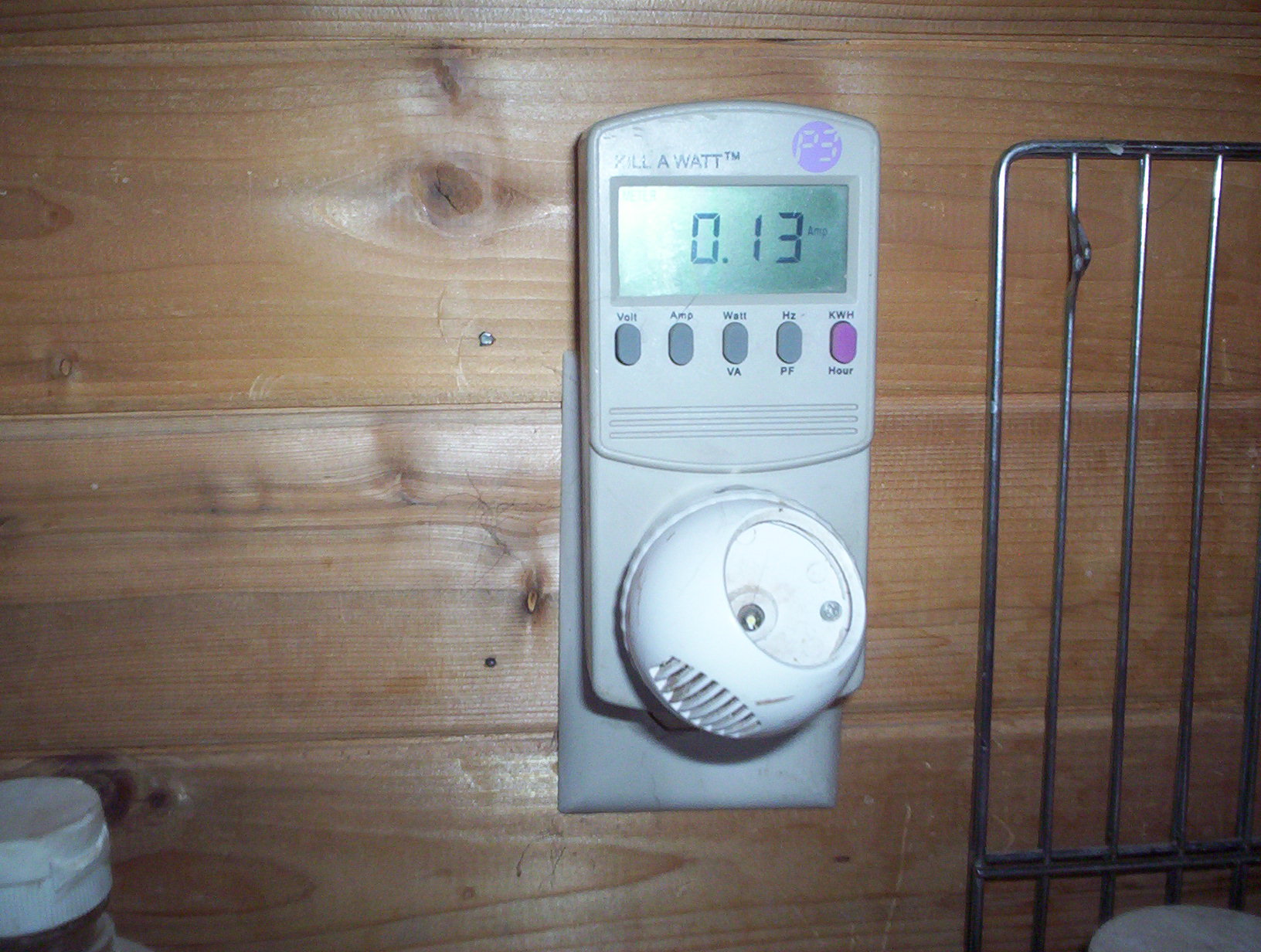 I borrowed this Kill-a-Watt from neighbor J. It’s a terrifically useful gadget for anybody with a roll-yer-own electrical system, and turns out to have a slightly disorienting flaw that should have been more obvious to me from the first: It draws electricity, which it duly adds to the measure of electricity drawn from whatever you’re measuring. Which throws off the totals somewhat.
Oh, it wouldn’t matter in a proper (big) electrical system. 0.1 amp: Who cares, right? Well, when you’ve got a less-than-400-watt system, those tenths add up and they’re what I’m (finally, belatedly) trying to track down. And right away I started getting weird numbers.
Plug the coffee grinder into it and read 0.9 amps: Well, that sounds about right. Plug a single CFL into it, and it tells me the thing draws 0.3 amps, which is twice what I expected. So I plugged in an automatic on/off nightlight the dogs bought me so I’d stop stepping on them on my way to the loft ladder: 0.15 amp? Wait just a cotton-pickin’ minute here. That’s the advertised draw of a CFL, and the nightlight has a single small LED. No way. It should barely register.
And it would barely register, if it weren’t for the parasitic draw of the Kill-a-Watt itself. Which I neglected to consider.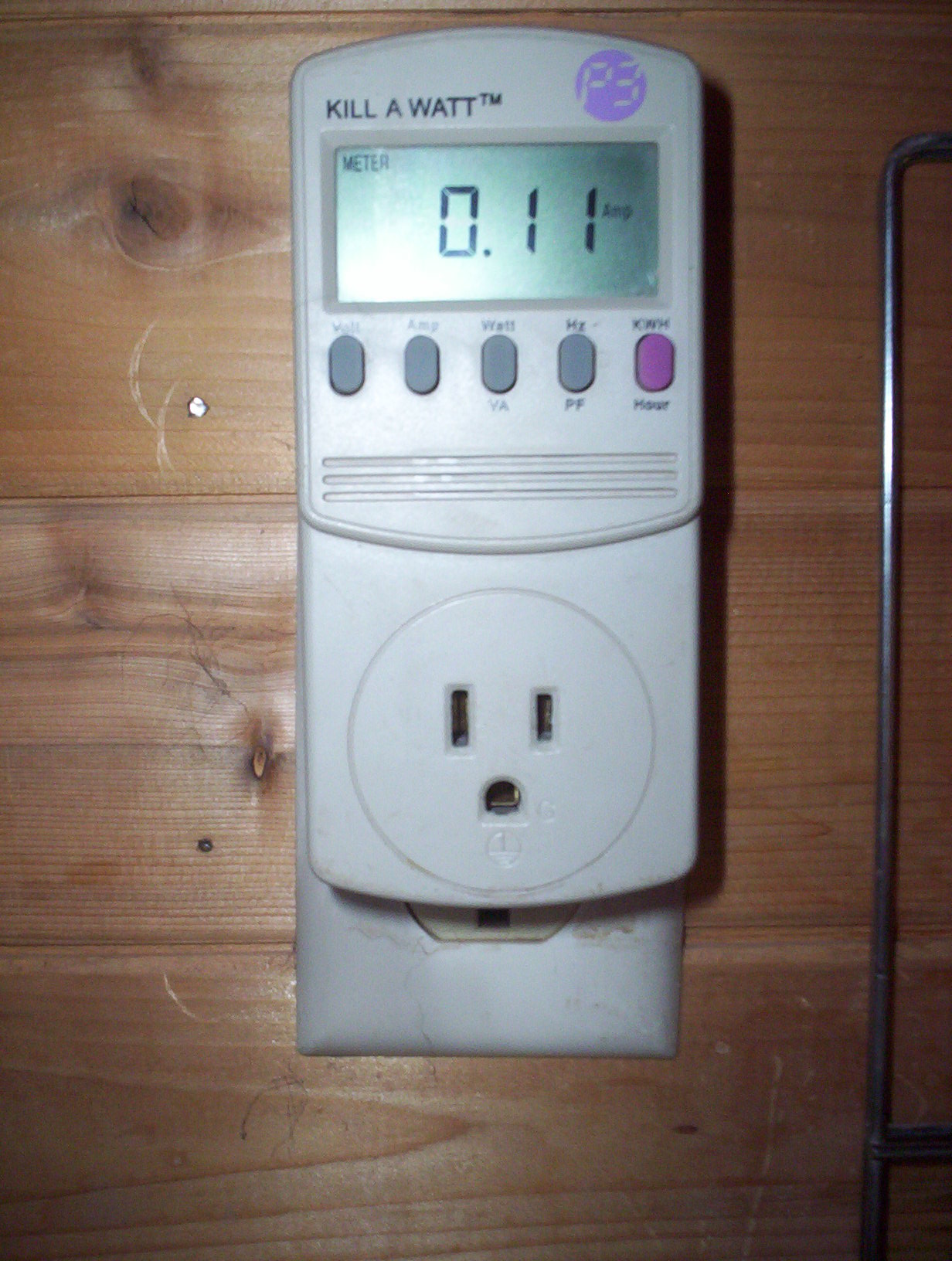 Live and learn. As always.















Belkin has a somewhat more advanced gizmo that does the same thing. Now I need to play with it to see what its parasitic draw is. It may be lower than the Kill-A-Watt but I’m confident it’s not zero.
While back I made a “circuit splitter” by stripping the sheath on 18 inches of Romex, exposing the insulated conductors within and adding a plug and receptacle at the ends; clamp-on meters need to see only one side of a circuit, either hot or neutral, to register voltage and amps, or fractions thereof, which is where this particular ship runs aground. In very low amperage territory the average (read: homeowner or basic technician) VOA meters just don’t accurately display current. I’ve tried to measure LEDs and the digital meters I’ve got all show “0” which I know is a lie – the LED is lghted, so current has to be flowing. I achieved an approximation by powering enough LEDs in parallel to draw enough current that the meter finally sort of woke up, and doing the math. The result is an average, inaccurate, certainly, but still slightly better than nothing.
Back in the day I used good oscilloscopes for this sort of stuff, but they’re out of reach now, and I’m not really that curious about tenth of a watt current draws. But, I don’t operate with a minimal-size solar system, either.
What Nosmo said about low-amp accuracy. Though 0.11 amps seems kinda high for that dinky meter. Could you verify the KillerWatt readings with another, different model meter?
And be happy you can grind coffee. I thought I was prepared to continue having convenient coffee during the zombie apocalypse with my solar panel and ac inverter. Wrong. The grinder’s ac motor won’t run off of the not-quite-right waveform coming out of the inverter. Imagine my horror. I can grind by hand, but that takes ten minutes out of coffee-drinkin’ time.
Robert, I reflect daily on how delighted I am that I can grind coffee. And that I have decent coffee to grind, which is entirely due to the machinations of Landlady.
For the cost, the Kill-A-Watt gadget (KAW) is an amazing bargain. But as you have discovered, that price point doesn’t buy you lab quality. It’s enough to know that AC loads can be notoriously difficult to measure, so take all measurements with the proverbial grain of salt.
An Amprobe clamp meter, along with that circuit splitter that NOSMO mentioned, might be another method to try.
Joel, are you wired for 12v power anywhere? In those cases where you can run 12v you can save a lot of power by not involving the inverter
No. I could have done, and considered it when I was wiring the cabin. But now three years later I’m just as happy I didn’t, frankly. I could have saved some power on 12v lights, but they wouldn’t work as well. And CFLs are nearly the least of my problems, usage-wise.
Of course if my inverter ever craps out I may regret that.
Of course(2) being a prepper, I have a spare. 🙂
They’re certainly not now at a cost point to make them economically viable, but with the advent of 12 volt LED bulbs, and assuming good LED bulbs carry no more cost penalty than the previously ubiquitous incandescents, or even today’s $/lumen of CFLs, would you reconsider a 12 volt circuit?
I recognize that lighting is, or can be, a very light overall electrical load in comparison to other loads, which may or may not be useful 12 volt alternatives. What I’m thinking of here is the extending of a required small (two 100 watt/day devices) 12 volt solar-powered circuit to incorporate slightly above minimal lighting requirements in an average size dwelling, and that such a circuit extension would benefit substantially from more expensive multiconductor wiring.
Sure I would. It’d mean some new wiring, but that’s simple enough. It’d need to give a measurable advantage, though. Possible with LEDs but like you said – the cost! Yeesh. And the CFLs already work. There are some disadvantages, but that’s mostly a question of preference.