Not trying to rain on your Easter parade, but it says here Peter Cottontail is headed for the scrapheap of evolution. You might consider being terribly concerned.
Conservationists seek to save ‘Peter Cottontail’ from extinction
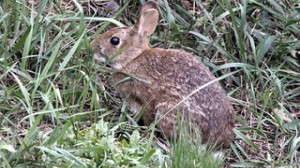
Me? Extinct? You gotta be kidding.
The species that inspired a New England author to pen tales about a curious bunny is in danger. Wildlife officials said the New England cottontail could face extinction because the shrub lands it calls home are disappearing.
The U.S. Fish and Wildlife Service has partnered with state agencies and private organizations from Maine to New York to restore its natural habitat and save the critter.
Is there really such a thing as a “New England Cottontail?” How does it differ from the “you kids stop swimming drowning in my dog’s water” Southwestern Cottontail? And does New England want some of those?
Because we’ve got lots.
Fortunately for the cottontails of New England, the government is here to help.
New England cottontails were abundant a century ago, but as neglected agricultural lands reverted back to forest, the population thinned.
Conservationists hope habitat management and captive breeding will prevent the species’ decline, which would require a more costly response and restrictions on land use and hunting.
I would point out to “conservationists” that that Northern Spotted Owl thing didn’t exactly do miracles for their credibility, and hasn’t been forgotten by people not interested in further “restrictions on land use.” Just saying.
However, in the interest of fairness and mild, idle curiosity I hied me over to the font of all human knowledge to see if there really is such a thing as a New England Cottontail. Says here the answer is yes. Sort of.
The New England cottontail (Sylvilagus transitionalis) is a species of cottontail rabbit represented by fragmented populations in areas of New England, specifically from southern Maine to southern New York.[3] This species bears a close resemblance to the Eastern Cottontail, which has been introduced in much of the New England Cottontail home range. The eastern cottontail is now more common in it.[4]
New England cottontails are virtually identical to eastern cottontails. The only way to tell them apart unequivocally is to view skull characteristics or by DNA analysis.
Save the New England Cottontail! Slaughter the Eastern Cottontail! (and for god’s sake stop with the inter-species miscegenation. You kids know what I’m talking about. Stop it right now. Yes, I know that black spot on her ears is really sexy but it’s wrong.)












The trick they’re using to pick and choose their definition of “species” very carefully. That’s pretty easy, because there really isn’t a single definition that all (or even most) biologists can agree on. Forget what you may have heard in grade school about a species being a genetically unique group that can successfully interbreed yielding fertile offspring. What these @$$holes use is something along the lines of “genetically similar, capable of of interbreeding with other groups, but GEOGRAPHICALLY SEPARATED FROM OTHER POTENTIAL BREEDING GROUPS. The definition is basically “lines” on a map rather than genetic or biological.
This is the same definition the d#mbf#ck Easterns tried to use back in the ’90s when they attempted to declare most prairie dogs endangered.
Come to think of it, one could make a good case for their definition by looking at most native Westerners and comparing them to the urban Left and Lefter Coast freaks. OTOH, that’s pretty much how they dehumanize Flyover Country folk in their own minds.
Damn this insanity is hilarious. They blame the farmer for driving off nature and now the blame the farmers lack of farming and letting the land revert to forest thus destroying Peter Rabbit.
See, this is why I could never be a reporter. I’d skip right past the press release about rabbits and start asking the Massachusetts government about this line: “The only way to tell them apart unequivocally is to view skull characteristics or by DNA analysis.” That actually appears on the website of the Massachusetts Division of Fisheries and Wildlife, so I’d kind of like to know how long it’s been the official position of the Massachusetts government that white people and black people are different species.
Where do I apply for grant money to save the Jackalope?
Ken, people have tried asking that question. The lib-tards just pull one of the other dozen or so “species” definitions out of their @$$es and tell you that you don’t know what you’re talking about. Convenient, that.
Species: 1. (politics) an environmentally variable distinction allowing the most control of semi-sapient populations whenever most convenient. (ex- “A species is whatever I say it is, especially if it’s endangered and I can stop you using your own land.”)
2. (biology) one of several ways of distinguishing between types of lifeforms commonly based on interbreeding potential or morphological differences that breed true; the term originated before it was realized that many lifeform do not interbreed; efforts to regularize a single useful definition applicable to all terrestrial lifeforms has been unsuccessful to date.
What will they think of next… “endangered” bed bugs?
Rabbits… of any kind, will be welcome food at some point, and I don’t think feeding any number of humans, coyotes or other predators will ever significantly reduce their numbers.
They breed… well, like RABBITS!! AGGGGGH
Oh, and by the way… prairie dogs are perfectly good eating too. They are not quite as easy to get as rabbits, and you need more than one… but good anyway.
As a biologist (and actually one with colleagues doing New England Cottontail research) I can back up what Bear said about the criteria for a “species” being very controversial. It’s a huge issue of contention within the field and often leads to ugly confrontations. Personally I can think of a hundred more useful applications of research money but that’s just me.
oh no,
biologists using the same highly dubious and ultra narrow definitions as the anti-trust crowd to justify extending their theft of OPM.
They’re welcome to a few tens of thousands of European bunnies from my place; it’s a few years since we had a good lamping session; four guys, one driving, one shining the lamp, a shooter and a picker upperer.
1,100 in 3 nights. If the guy doing the shooting had hit every time, there’s have been 1,500 plus.
The old man has taken pity on the local brown hares (they’re like jack rabbits) they die very quickly in snowy weather, and the British Met Office has reluctantly admitted that this has been the coldest month of March in Britain since 1962 (no mention of hockey stick graphs or cAGW either!), so he’s feeding them every night. he’s got about 9 of them coming.
I bet they taste the same and that would be all I cared about.
The bunnies don’t need no gubmint protection. Nobody messes wit da bunnies! Nobody damit!