Every time I do something new and exciting to the Lair’s roof I think about rain barrels – then I chase something shiny and forget it till next time. It’s never really been a serious matter to me because I don’t normally have to work hard for my water. I have the luxury of mostly-dependable water at good pressure and I don’t garden, so why bother with a hundred gallons or so of buggy slimy goo? Two simultaneous developments put the topic a little more seriously in mind at the moment.
First, this new bedroom addition absolutely must have a gutter, and the water must be channeled somewhere non-damaging. While I’m at it I may as well do the same to the main roof, which has historically presented less of a runoff problem. This would also be a good time to at least examine the matter of rain catchment.
Second, this week I’m getting a nice education in the subject from someone in the area who does have water issues, and who does garden, and who has considered low-cost rain catchment.
Down on the flat around his barn, his approach is distinctly low-tech…

…and as you can imagine those barrels are filled with buggy slimy goo. Just dipping a bucket into them makes me want to shower in hand sanitizer, and I’m not Gerry Germaphobe. But if you’re just watering plants, it works.
Up on the mesa there’s a hidden sunny/shady/houseplant-infested courtyard. It’s surrounded by house, its perimeter is ringed with roofed porches all of which have gutters that drain to something a bit more elaborate and expensive – similar to this (though I note extremely poor reviews for the example shown) …
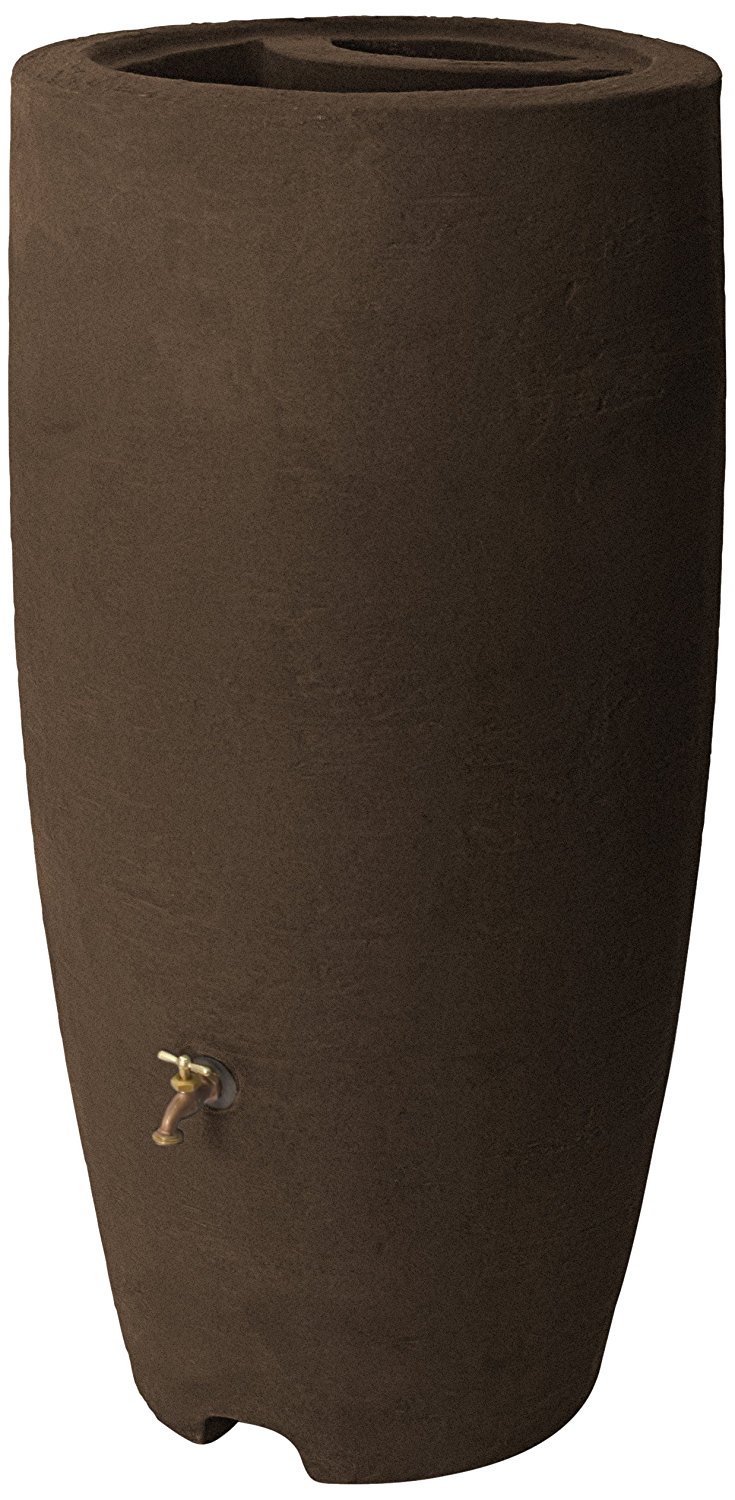
Anyway, as I mentioned earlier these folks have chronic water issues because they dug their well on the plateau and built their house on a mesa maybe 150′ higher. The guy left me a whole bunch of cat litter jugs full of water, and I emptied almost all of them watering the courtyard once. So this morning, since the rain barrel was full, I took the opportunity to refill all those jugs in hope more rain would refill the barrel. What happens when the barrel overflows, I fear I may learn this week.
For my own use this still seems like a solution in search of a problem, frankly. I have more trouble with too much water than with not enough – but I do concede that when “not enough” happens every 3-4 years it suddenly becomes a big problem. Do I want to solve it with water that’s been 3-4 years in barrel? Not really.















You could always cut right to the chase and ignore all the stuff in the middle. Figure out a good placement for a cistern, and be done with it.
“cistern, and be done with it.” You know, I’ve often wondered about that. Is there anything magic about a cistern that keeps the water from getting all icky without using chemical additives?
In my childhood I remember visiting an old farm house that had a concrete cistern in the basement that was at least the size of a large closet. That cistern was apparently once an important part of the house water supply, and I assume that roof runoff was it’s water source. I doubt if laundry bleach was available in the era that house was built. So somehow they must have had a way of keeping their stored water drinkable.
What is/was the secret?
I’ve wondered the same thing and can only offer a theory. Most cisterns I see, including mine, are opaque dark plastic with heavy sealed covers. Never seen one fouled, even if there’s not much water turnover. But these things – white translucent plastic and very common around here – are frequently so nasty you’d rather die of thirst than drink from one. I think the trick is keeping it bug free and away from light.
As child in Caracas in the 60s and 70s water supply was sketchy at best. Public works would open the tap once every couple weeks or whenever the felt like it. Consequently all houses had underground cisterns holding a couple thousand gallons. The routine was to throw a couple large chunks of rock sulfur in there and it kept the green slimy nasties away. Household drinking water was kept in a device called a “Tinajero” (google it) . The device consists of a large sandstone rock bowl placed over a lager earthenware pot in a large cage like armoire. Each would hold about 5 gallons. A golf-ball sized chunk of sulfur rock was kept in the upper sandstone bowl. The water from the top bowl would seep through the sandstone filtering it, the sulfur purified it.
I haul my garden water so I have rain barrels to catch what I can especialy for the tomatoes as the ph of the public well is not ideal for tomatoes. A window screen over the barrel keeps the spruce needles and moquitos out of the barrel. Should work for desert bugs too. I have a big table top filter in the shed in case I have to use rain barrel water to drink.
Yep, it all comes down to cleanliness and lack of light. Everything’s gotta eat and no light means no algae/plants. No plants means no bottom of the food chain and consequently no chain at all. The only other alternative is decomposers (fungi like mold and mushrooms) but without anything to rot they’re SOL too. As weird as it sounds, pure, dark water is a lot like a desert from an organismal point of view.
Keep it dark and stick a screen over it and you should be good to go.
“including mine,” Wait… You have a cistern? Tell us more.
I have a 2500 gal dark plastic water tank, which I have always called a cistern even though that’s not technically correct.
That’s the one that’s part of your water system?
Yeah.
We have, and use daily, a “modern” concrete-coincident-with-the -house-foundation, cistern. Been using it for thirty years. I’m pretty sure the secret is keeping it dark, and buried in the ground keeps it pretty cool, as well. Keeping critters out is a given.
My rain barrel system is four blue 55g barrels with the tops cut off. I then spray painted them cream to match the house and to help protect the plastic from the sun. I do need to rig screens to cover the tops, the mosquitos are a pain, but keeping biological mess out is a bit hard here. If I had to drink that water I’d want one good quality filter. But when we get our dry spell every August it comes in handy for watering the garden!
Lowes has Rubbermaid Roughneck Sheds that are occasionally on sale for $199. Even if you have the white translucent barrels, they will fit in this shed and keep the light out. I also put a small heater in here in the winter and prevent my faucet from freezing. I make a small hole in the back of the shed to drain from gutter to barrel. Have found that the Leafsout gutter guard from Amazon works best to keep debris out of the gutter and even filter water. As said before no light is important but also using water as barrel is filled helps a lot too, particularly in summer heat. I would drink the water fresh off of a nontar type roof with no other filter than Leafsout.