A few weeks ago during the annual June heatwave I happened to step into D&L’s earthbag-and-strawbale extravaganza, which took more than five strenuous years to build, and it was like visiting an air-conditioned library. It was really nice. They have learned since building it that maintaining that effect requires effort. In summer it’s pretty obvious stuff the Egyptians understood: Close it up in the day, open it up at night. In winter, a week’s vacation elsewhere is basically out of the question unless you’re prepared to spend days heating up the interior again because once all those many tons of dirt inside the walls have dumped their heat they’re very reluctant to pick it up again. Thermal mass works both ways.
Ian’s place, being underground, has the same problem but either less or more, depending on how you look at it. His house is basically a cave now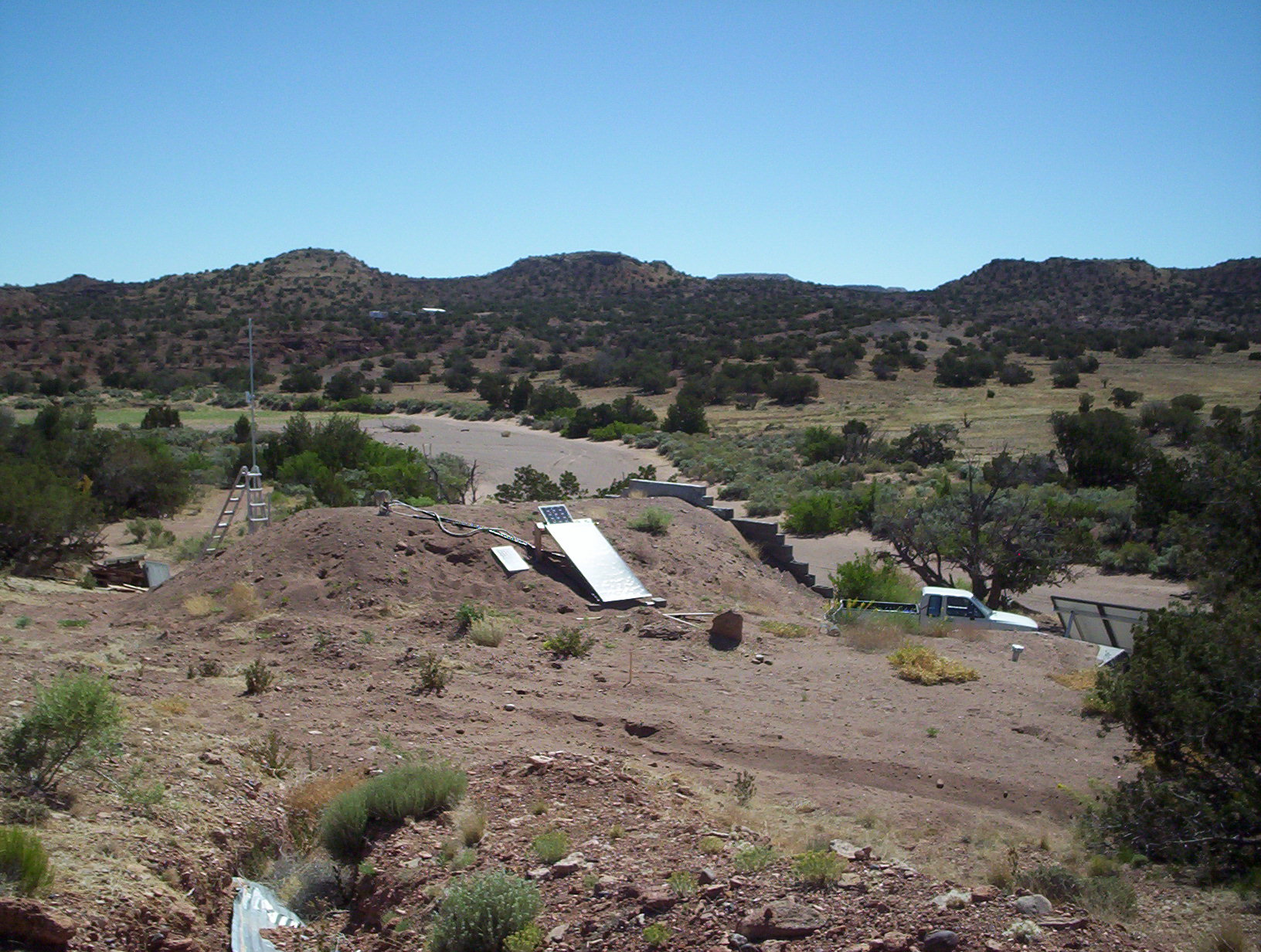 and will certainly answer any questions you have related to thermal mass, summer or winter. Unfortunately in hindsight it might have served us to do something more elaborate in regard to ventilation: You can’t do the ‘open it up at night’ thing. Now we’re past the annual heat wave and sliding into Monsoon, and it’s not only hot in there – not half as hot as it can get outside, but still not cool – but also muggy. And you apparently can’t change that. I got to wondering yesterday if it might not be possible to cool things down in there by putting this big industrial-strength fan he’s got in front of an open front window and letting it run all through the cool of the night. This is not an experiment I would care to run at the Lair because I don’t have the electrical capacity. But I could do it at his place, especially since nobody lives there and so there’s almost no other draw.
It has rained all this morning and clearly we’re not going to get a good recharge, so I figured I’d better go up there between showers and turn the fan off. Checked the power and the thermometer I set deep in the interior and found that I had used 26% of his battery charge and lowered the temperature a big 5o. So that didn’t work.
Walked home thinking, “Some 4″ drain pipes might have been a good idea. Cap them with some screens. Ventilation! What a concept!”
Live and learn, I suppose. By comparison the Lair is a very small frame structure with a freakishly high ceiling and no thermal mass to speak of. On very hot days it gets quite toasty in there by the afternoon, but it’s well ventilated and cools off well in the evening and the high ceiling gives the heat someplace else to go. Downsides: The bedroom is up in the loft and is of course the last thing to cool down. If we don’t get an evening breeze, this can affect your sleep but usually we do. I’m certainly glad I put in those upper vents. And in winter, that 14-foot ceiling becomes – not a curse exactly but certainly a disadvantage. In the first winter before I got a decent wood stove I’d light the fire and then go spend an hour in the loft since it heated up long before the main floor did. Now it’s not that big a problem but there’ll never be a winter when I don’t wonder if I wouldn’t have been happier with a lower ceiling. So I guess everything’s a trade-off.















I’ve wondered about the same things, and IIRC, mentioned them here; on the thermal mass, the insulation needs to be on the outside. Since no one builds structures that way, despite the attractiveness of the concept there must be something wrong with it in practice.
I’ve had houses in hot climates, and high ceilings are standard. Unfortunately, that doesn’t help during the (fortunately very short) cold period. An adjustable ceiling seems like it might be a partial solution, but, again, no one is building houses that way. As far as the lair is concerned, though, might some sort of temporary fabric barrier work to keep heat at the lower level?
How about a 12 volt ceiling fan for the winter. I have seen some in the catalogues that were really low wattage. That would pull heat down with out the power loss of running the inverter. Might also work on summer evenings to cool your loft soonet
Those 4 inch pipes run into Ian’s cave would line up with the idea I had for ventilation…well…the one I stole from the Middle Eastern abodes I am familiar with. 6 inch pipes, 5 feet under ground run at 100′ lengths with elbows that suck air in and deposit it into a hot house.
A similar plan for hot air in Wintery times involves a box full of pipes made to resemble a radiator and some reflective stuff, a can of heat resistant black paint.
I already have sort of this arrangement in Philippines for hot water.
Howard, I actually have a switched power box in the ceiling for a fan. My first electrical system just wouldn’t support it, and afterward I kind of forgot the whole thing. I really should shop for a low-wattage fan, but there’s always something far higher on the spending list.
Re: Nosmo,your adjustable ceiling idea is maybe impractical,but here’s some input.I live in a two story house in the southeast,with bedrooms up and down.I have central air,but don’t use it much-cause I’m cheap.
In the summer,it’s unbearable upstairs,so I sleep downstairs with a ceiling fan on.In the winter,however,it stays warmer upstairs all night even without the heat on,so when the weather is cold(not very often),I sleep upstairs.
Kind of your idea,taken to extreme.
I’ve heard a problem with ventilation tubes (in the ground) is that there is a lot of condensation in them, leading to mold. Not the sort of thing you want in your ventilation…
A friend and I decided to try earthbag. We built a house for him, way too big. Never really finished, the roof didn’t get done and the place is probably used as a goat shelter by now (we sold the land). But I was amazed, on hot days, even without any roof insulation that place stayed cool inside. One tip for earthbag: buy a bobcat first. You are talking about moving a shitload of mud…
I’ve fantasized about building a small dwelling like yours Joel. I’ve got a whole notebook full of designs. The object was always cheap, good, energy efficient housing. How about a small earthbag home, with good south-facing glass, covered with straw and with tarps or epdm on top of that? If the cover extends far enough out, the soil in winter will not conduct heat as well away from the house, because it stays dry. But getting all the elements working together is very difficult. It’s no wonder every country with access to wood uses stick-built for almost all individual homes.
To me, watching various neighbors succeed and fail, the choice of building method seems to come down to “do you want to build it, or do you want to live in it?” Is your objective the journey or the destination? The one great selling point of frame construction is you can just build it and be done. If you’re embarking on an adventure maybe you won’t mind spending months filling sandbags with dirt, the only reward being the sight of your slowly-growing walls. Work through to the finish and you might have something marvelous: D&L certainly do. D&L have also been working seven days a week for almost ten years. They spent the first year and a half just building their workshop, learning earthbag and adobe. I wouldn’t have made it.