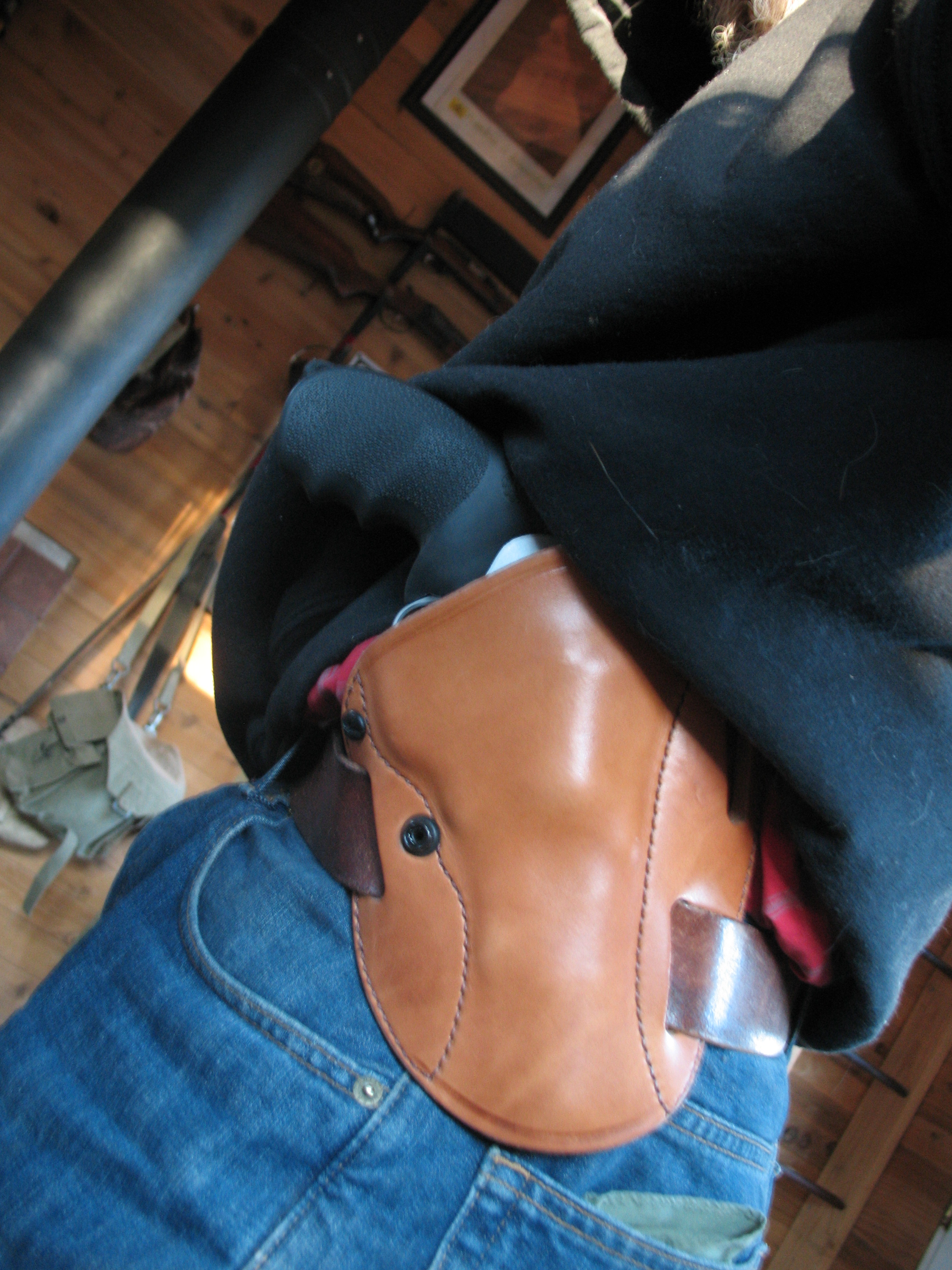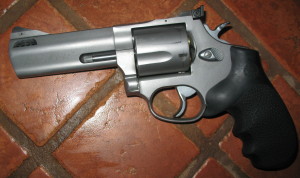
A little less than three weeks ago I took possession of this 4″ Taurus Tracker, new in box. In that time I’ve carried it every waking minute, fired just over 300 rounds of various lots of ammo through it, and generally treated it like the EDC gun I got it to be. Wanted to hold off on writing a review until I had thoroughly gotten to know it.
All in all, for an inexpensive revolver it does the job very well and I expect us to be friends. I’m told this particular gun became available on consignment when an expensive elk-hunting expedition fell through, the hunter having purchased it as a backup specifically for that trip. So I got a good price for it, but it was new and unfired when it arrived at the Lair.
Frankly if this were a zillion-dollar Smith & Wesson I’d have gone bitching to the seller, because the Taurus is not without flaw. In particular may I say that when you carry a handgun for serious purposes, as I do, the most disturbing noise the gun can make is “click.” And this one sometimes makes that noise. I’ve now owned two Taurus revolvers, and both were prone to light strikes on hard primers when firing double action. With the Tracker, this has now happened three times in 250 rounds of reloads with notoriously hard CCI primers. It has never yet happened with commercial ammo, nor has it happened in single action. My old 431 had the same issue – in fact it did the bad thing chronically until I replaced the mainspring. But the 431 was 20 years old, used hard and frequently put up wet. I would think a NIB revolver would not suffer the same failing, but it does.
So, there’s that. Of course I don’t carry the gun loaded with handloads, because I’m not a moron. Handloads are for practice, and things like this are why I’m notoriously stingy with commercial ammo at the range. But because I’m interested in learning all the tricks and vices of this gun I will use to defend my life and/or that of my animals, lately I’ve been spending commercial ammo as if I’d just come back from picking it from the Ammo Tree. My experience is that primers in commercial ammo don’t normally give the same problems, and so far they have not.
Which brings us to the issue of Magnum ammo and the barrel porting…
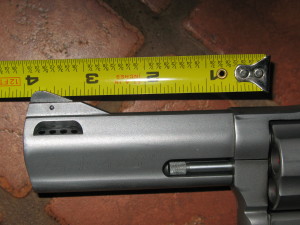
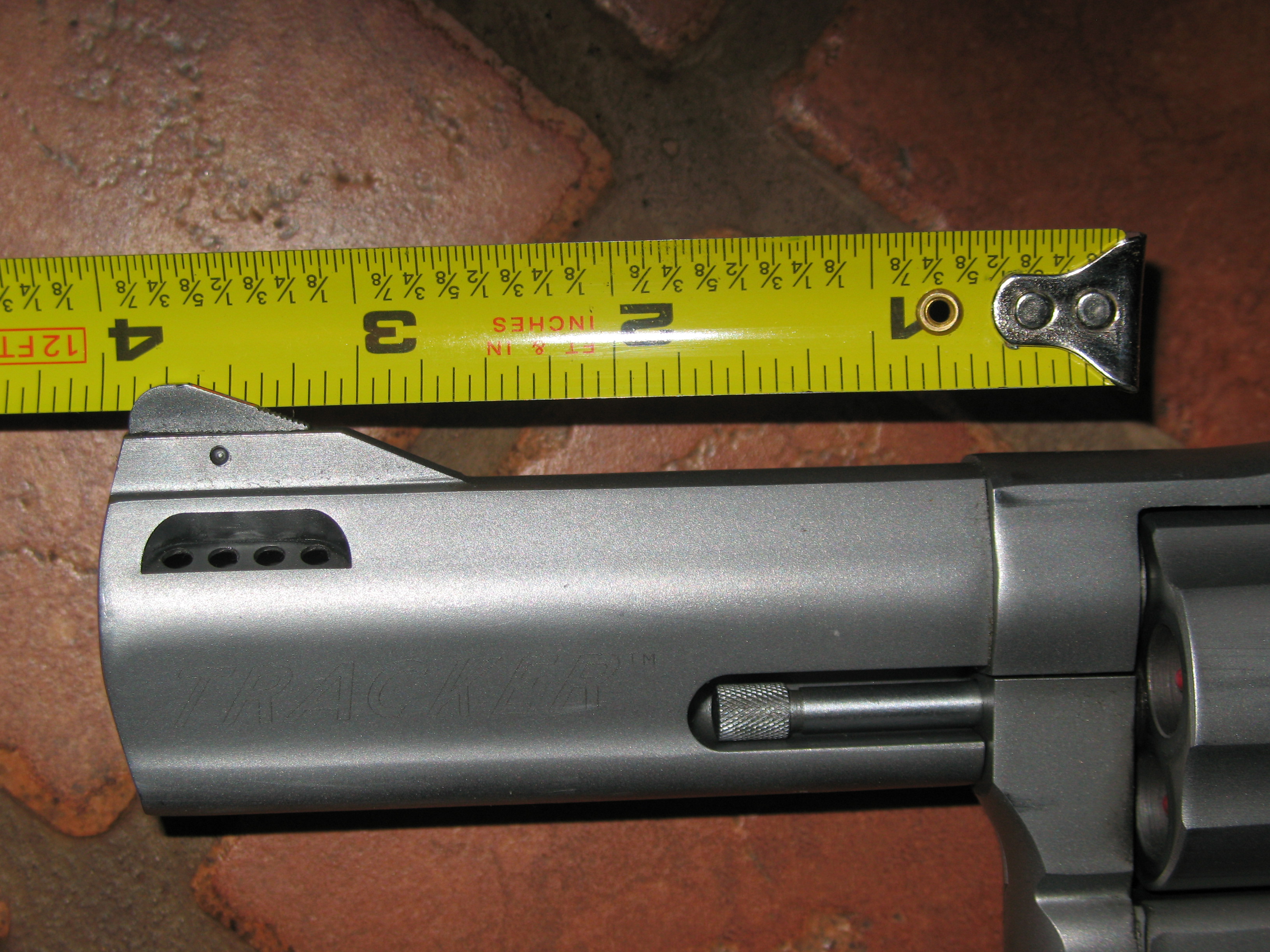
This particular pistol has a feature I’ve never encountered on a revolver with barrel porting. In the old days they just bored holes in the rifled barrel. But this gun has a ported and unrifled expansion chamber in the final inch, so it’s more like an integral muzzle brake. This provides the advantage that it doesn’t matter what kind of bullets you choose to use. In the old days, you were supposed to avoid shooting cast bullets because bits of bullet would peel off into the ports. On this gun, that’s not a factor. But it does mean that calling it a 4″ barrel is somewhat disingenuous. It’s really a 3″ barrel with a brake.
But does it do any good? I’d need an identical gun without the porting to do anything like a scientific comparison, but I’m going to go with yes. And here’s why:

Those five upper plates have made themselves my enemy for a long time. But the Taurus has largely tamed them. At 12 yards – and when I’m on my game, at 25 yards – I can get them all swinging. Never could do that with the 431. A lot of it is the much-improved sights, but just as important is the fact that this gun doesn’t give me nearly as much muzzle flip. No doubt the longer barrel is involved, but as we’ve already established the barrel is for practical purposes not but 1/2″ longer. So if old Uncle Joel is suddenly a better pistol shooter than he was last month, we’ve got to give the gun its due.
Of course that’s with light .44 Special loads. Commercial .44 Magnum ammo is startlingly more powerful than that. With Magnum loads, the lightweight gun of course becomes a handful. In the old days 35 years ago, when I competed with .44 Magnum, I had a Super Blackhawk and a heavy-barreled T/C Contender. With those guns you got one shot at a time, because after each shot your barrel was pointing at the sky. The Tracker is not a big heavy hogleg: If follow-up shots using full-power loads suddenly become easier to acquire, it’s got to be because the muzzle brake is not just styling. And I can testify that that is indeed the case. I’m not saying there’s no muzzle flip, of course there is. But this gun is not as uncontrollable with full-power ammo as it has every right to be. So the muzzle brake works.
But the Taurus Tracker is still an inexpensive revolver, and that has to show up somewhere. Some of it is in the manufacturing corners cut…
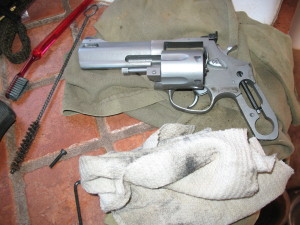
Expose portions of the gun normally covered by other components, and you find that they only finished the portions of the gun that are normally seen. I’ve stripped a S&W Model 29, and it was perfect in every way. A Taurus Tracker’s hidden bits show rough machining cuts.
Then there’s the matter of that dumb stock “Ribber” grip, which is demonstrably inferior to a proper grip. I spent money right up front on a Hogue grip for the Tracker, and already have reason to be happy I did.
So. All things said, the Taurus Tracker is not the perfect revolver. But that fact is reflected in its price point. If you understand that you’re buying an inexpensive revolver, and that revolvers are not inexpensive to manufacture, it appears to be a very good gun for what you’ve paid for.
I think we’re going to be friends.
UPDATE: Uh oh.
ANOTHER UPDATE: Long-term Review: A Tale of Three Pistols